Belo Monte Dam: Amazon Watch
Help preserve their culture.
How unconscienable is this! The Brazilian government is now moving ahead on a project that will result in the construction of the third largest dam in the world in one of the most diverse and ecologically rich areas of the world: the Amazon. It is to be constructed on the Xingu River which is home to the Paquacamba and Arara indigenous peoples.
It will divert 80% of the river from its original course, thus leaving swaths of indigenous land in drought while flooding over 100,000 acres of rainforest and displacing 20- 40,000 people. Once again we see shortsightedness at a time when we need to see the big picture. Hydroelectricity in areas such as this in an age of global warming and drought is a short term solution that will only bring long term consequences to environment, economy, culture, and also the climate balance of the planet.
Solar energy is the one renewable energy source that is most viable here that will also preserve the environment, water resources and culture of the indigenous peoples who call this area their home. This action will then in turn spawn multiple dam projects all the way up the Amazon that will only displace more people when it is not necessary.
It is heartbreaking to see what is being done to the last vestiges of ecological richness that we must preserve for the future. There is still time however to tell the Brazilian government you oppose this. I will post a link below where you can do this.
Thanks.
There are other ways!
Stop The Belo Monte Dam
Sunday, December 05, 2010


Thursday, November 25, 2010
Earth: What I am thankful for today and everyday
I have devoted my life to caring about the biodiversity and health of our planet and will continue to do so until the day I die. This Earth, this beautiful amazing orb in a vast universe, the source of all life, is what I am most thankful for today and every day.
I am thankful for its mighty water that is its lifeblood and ours
I am thankful for its soil that preserves and sustains the miracle of our sustenance
I am thankful for the sun that warms us body and soul
I am thankful for the wind that reminds us of its fury and power
I am thankful for all creatures who live in harmony with man
I am thankful for the seed, the most miraculous wonder on Earth.
From one tiny seed we can cultivate life for millions.
May we as humans truly see how much we have to be thankful for every day and come together now to understand that in order to show that thankfulness and to be one with this living Earth, we must treat her with kindness and respect.
Saturday, November 20, 2010
Overpumping Drawing Down World's Groundwater Reserves

Overpumping Drawing Down World's Groundwater Reserves
This is why it is so crucial to have investment in water infrastructure, drip irrigation, rainwater catchement, strict penalties regarding private companies depleting gorundwater resources for profit such as as Coca Cola in India. And also, a climate treaty that takes into account water issues and climate change issues that are intertwined such as glacier melt, floods, and sea level rise as well as drought. What is even more important is educating people as to the hydrologic cycle and how we as humans are now changing its course which must spur conservation. This is the moral crisis of the 21st century.
Friday, October 15, 2010
Blog Action Day: The Global Water Crisis Looms Large Over Our Planet

It is a tragic scenario we see playing out on our only home. With new predictions from scientists that Arctic glaciers may be gone within 30-40 years and other glaciers around the world melting three times faster than worse case scenarios what are we going to do to preserve the dwindling freshwater resources we are certain to see strained in the next fifteen to twenty years even more than they are now? These glaciers are the water source for over two billion people on our planet and they are shrinking faster every year not only through glacier melt but a melting will to do the right thing and to face this crisis head on.
One-third of the world’s population is now in need of potable water which was a scenario not predicted to happen until around 2025 and which is now predicted to get worse unless things change drastically. There are 2.6 billion people on our planet without even basic sanitation! What does that say about our moral conscience and our priorities? We are nearly twenty years ahead of predictions on the effects of this crisis and yet we are woefully unprepared for the consequences. There is no other way to state this: unless we work to solve this global water crisis now in an equitable way, many of the poor and malnourished in our world where this crisis is most dire will die.
We are reaching the breaking point in many areas of our world due to waste, pollution, mismanagement, lack of water infrastructure, dams, inadequate water infrastructure and privitization which is an inhumane abridgement of global human rights. And now, the ever encroaching spectre of climate change threatens our very relationship to the planet we call home in ways we could not have imagined just thirty years ago. So what accounts for the lack of will in taking this on fully? Apart from political/ideological rancor, I believe it is basic misunderstanding by people (especially in America) that water is an infinite resource that we can continue to use without any concern for tomorrow.
It isn't. And we can't.
Therefore, areas where the poor are looking for a way to not only lift themselves out of poverty but also have a chance at survival must be shown ways to conserve water such as rain catchement, rain agriculture, and effective conservation. This also then ties into people in these areas having information about the climate crisis and its effects and how they can best deal with those effects. The Yellow River basin in China which feeds literally millions of people is just one example of resources exhausted to the point where they can no longer sustain life. Where would those millions of people go?
Just what are we doing?
Is it really that hard to bring better agricultural techniques to farmers in these countries? Is it really that hard to teach them how to deal with the effects of climate change? Is it really that hard to actually do as we say must be done?
* rain water agriculture- cheap, efficient, and saves water.
* rain water catchment (off houses and roads)- cheap, efficient, and saves water. And of course, the health and safety of those using it must also be taken into consideration.
* less water intensive crops farmed sustainably that yield more to give farmers more for their planting.
* pressure bought to bear on governments to shore up water infrastructure and work to eliminate corruption and mismanagement.
* planting trees in the most deforested areas to bring water to the source and provide sustinence.
* also providing information and services for women and men in third world countries regarding birth control and health and basic sanitation.
* and one very important goal, to include water and this crisis in any global climate negotiations!
These are just some ways to begin which are all possible, but like with anything else those involved in it must also feel hope for the future.
As to how that should happen, we need a "Global Water Marshall Plan" (reference to the Honorable Al Gore's term from his book Earth In The Balance) in our world where that truly holds polluters accountable and where we also work to bring water saving energy sources to areas that are parched, drought stricken and in need of water to grow food and live. This brings me to the subject of dam projects which are increasing exponentially in many developing countries in an effort to provide energy, only all they are doing in the process in many instances is taking away water sources from those who need it most to live and displacing millions of people from their homes and cultural centers.
Renewable energy (solar, wind, geothermal) and sustainable agriculture could go hand in hand in saving many people from starvation and death in these areas, but dams are not always the answer nor are they "green." Instead of simply jumping to this as a solution in order to make governments and contractors profit, we need to assess more accurately the true needs of the areas in question and work with the people of these areas taking their imput into account. There is too much emphasis on profit and not enough emphasis on caring about life.
The climate/water crisis will change our relationship to the planet and action must begin now or the need for water globally will far exceed capacity to provide it. By doing the moral thing we could actually decrease global demand by half. And part of this is in declaring water a GLOBAL human right which we are getting closer to as seen just recently in Geneva. That is crucial to equitable access and keeping scarce resources out of the hands of greedy corporations looking to make a profit off the hardship of others.
NO ONE in this world should have to die due to a lack of clean potable water!
However, before we can accomplish this we must admit to our human frailty, take responsibility for it, and work together as a global community in understanding that when our water resources are polluted, toxified, misused and used in violation of the rights of others that is in direct antithesis to our purpose on this planet. As I look out on the future of water even with the crisis we see before us, I do see countless people who revere it, cherish it, respect it and work diligently to preserve it. In this age we live in now where those forces making profit from doing the opposite become stronger, we must stand firm against them. We are being given a choice and we are at a crossroads as a species.
I think the choice is clear, and it is a choice we all have to make.
Water is sacred
Water is the lifeblood of our Earth
Water is life!
Thursday, October 14, 2010
October 15: Blog Action day: Water
October 15, this Friday is Blog Action Day when thousands of voices across the Internet speak out for one important issue affecting us all. This year the issue is water, and it could not be a more important and crucial issue. From climate change, pollution, to privitization water is quickly becoming a resource we will have less of if we continue to ignore this defining issue of our future and that will leave us without a future.
This blog will be participating in this and I hope if you have one you will sign up as well.
Saturday, August 21, 2010
Water shortages to hit 1/3 of U.S. counties by mid century
Water Scarcity Facing 1/3 of U.S. Counties

One out of three U.S. counties is facing a greater risk of water shortages by mid-century due to global warming, finds a new report by Tetra Tech for the Natural Resources Defense Council.
For 412 of these counties the risk of water shortages will be "extremely high," according to the report, a 14-fold increase from previous estimates.
In the Great Plains and Southwest United States, water sustainability is at extreme risk finds the report, which is based on publicly available water use data from across the United States.
"This analysis shows climate change will take a serious toll on water supplies throughout the country in the coming decades, with over one out of three U.S. counties facing greater risks of water shortages," said Dan Lashof, director of the Climate Center at NRDC. "Water shortages can strangle economic development and agricultural production and affected communities."
"As a result," he said, "cities and states will bear real and significant costs if Congress fails to take the steps necessary to slow down and reverse the warming trend."
Counties shown in dark red are at greatest risk of water shortage by 2050. (Map courtesy Tetra Tech)
The report, issued Tuesday, finds that 14 states face an extreme or high risk to water sustainability, or are likely to see limitations on water availability as demand exceeds supply by 2050.
These areas include parts of Arizona, Arkansas, California, Colorado, Florida, Idaho, Kansas, Mississippi, Montana, Nebraska, Nevada, New Mexico, Oklahoma, and Texas.
Sujoy Roy, principal engineer and lead report author, Tetra Tech, said, "The goal of the analysis is to identify regions where potential stresses, and the need to do something about them, may be the greatest."
"We used publicly available data on current water withdrawals for different sectors of the economy, such as irrigation, cooling for power generation, and municipal supply, and estimated future demands using business-as-usual scenarios of growth," Roy explained.
"We then compared these future withdrawals to a measure of renewable water supply in 2050, based on a set of 16 global climate model projections of temperature and precipitation, to identify regions that may be stressed by water availability," Roy said. "These future stresses are related to changes in precipitation as well as the likelihood of increased demand in some regions."
The report also is based on climate projections from a set of models used in recent Intergovernmental Panel on Climate Change work to evaluate withdrawals related to renewable water supply.
Water withdrawal will grow by 25 percent in many areas of the United States, including the arid Arizona-New Mexico area, the populated areas in the South Atlantic region, Florida, the Mississippi River basin, and Washington, D.C. and surrounding regions, the analysis projects.
____
Hmm, do you think it might be a good move to stop building golf courses in the desert? We already see the signs of this with the Colorado River no longer flowing to the Gulf, and with drought hitting California Georgia and other Southwestern states. Conservation is a word that cannot be stressed enough. It isn't just poor countries that can feel the effects of water waste combined with climate change. Our water future is of our own making.
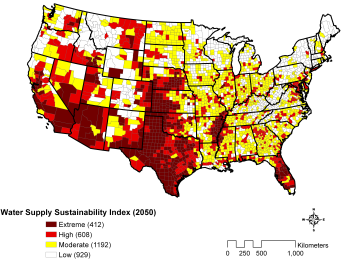
One out of three U.S. counties is facing a greater risk of water shortages by mid-century due to global warming, finds a new report by Tetra Tech for the Natural Resources Defense Council.
For 412 of these counties the risk of water shortages will be "extremely high," according to the report, a 14-fold increase from previous estimates.
In the Great Plains and Southwest United States, water sustainability is at extreme risk finds the report, which is based on publicly available water use data from across the United States.
"This analysis shows climate change will take a serious toll on water supplies throughout the country in the coming decades, with over one out of three U.S. counties facing greater risks of water shortages," said Dan Lashof, director of the Climate Center at NRDC. "Water shortages can strangle economic development and agricultural production and affected communities."
"As a result," he said, "cities and states will bear real and significant costs if Congress fails to take the steps necessary to slow down and reverse the warming trend."
Counties shown in dark red are at greatest risk of water shortage by 2050. (Map courtesy Tetra Tech)
The report, issued Tuesday, finds that 14 states face an extreme or high risk to water sustainability, or are likely to see limitations on water availability as demand exceeds supply by 2050.
These areas include parts of Arizona, Arkansas, California, Colorado, Florida, Idaho, Kansas, Mississippi, Montana, Nebraska, Nevada, New Mexico, Oklahoma, and Texas.
Sujoy Roy, principal engineer and lead report author, Tetra Tech, said, "The goal of the analysis is to identify regions where potential stresses, and the need to do something about them, may be the greatest."
"We used publicly available data on current water withdrawals for different sectors of the economy, such as irrigation, cooling for power generation, and municipal supply, and estimated future demands using business-as-usual scenarios of growth," Roy explained.
"We then compared these future withdrawals to a measure of renewable water supply in 2050, based on a set of 16 global climate model projections of temperature and precipitation, to identify regions that may be stressed by water availability," Roy said. "These future stresses are related to changes in precipitation as well as the likelihood of increased demand in some regions."
The report also is based on climate projections from a set of models used in recent Intergovernmental Panel on Climate Change work to evaluate withdrawals related to renewable water supply.
Water withdrawal will grow by 25 percent in many areas of the United States, including the arid Arizona-New Mexico area, the populated areas in the South Atlantic region, Florida, the Mississippi River basin, and Washington, D.C. and surrounding regions, the analysis projects.
____
Hmm, do you think it might be a good move to stop building golf courses in the desert? We already see the signs of this with the Colorado River no longer flowing to the Gulf, and with drought hitting California Georgia and other Southwestern states. Conservation is a word that cannot be stressed enough. It isn't just poor countries that can feel the effects of water waste combined with climate change. Our water future is of our own making.
Tuesday, August 10, 2010
Hydropower Dams Pose Threat To Tribal Peoples

Hydroelectric Dams Pose Threat To Tribal Peoples, Report Warns
Giant hydroelectric dams being built or planned in remote areas of Brazil, Ethiopia, Malaysia, Peru and Guyana will devastate tribal communities by forcing people off their land or destroying hunting and fishing grounds, according to a report by Survival International today.
The first global assessment of the impact of the dams on tribes suggests more than 300,000 indigenous people could be pushed towards economic ruin and, in the case of some isolated Brazilian groups, to extinction.
The dams are intended to provide much-needed,low-carbon electricity for burgeoning cities, but the report says tribal people living in their vicinity will gain little or nothing. Most of the power generated will be taken by large industries, it concludes.
At least 200,000 people from eight tribes are threatened and a further 200,000 people will be adversely affected by the Gibe III dam on the Omo river in Ethiopia. Ten thousand people in Sarawak, Malaysia, have been displaced by the Bakun dam,which is expected to open next year, and a series of Latin American dams could force many thousands of people off their land.
The authors say enthusiasm for large dams is resurfacing, driven by a powerful international lobby presenting them as a significant solution to climate change. Lyndsay Duffield, said: "The lessons learned [about the human impact of large dams]last century are being ignored, and tribal peoples worldwide are again being sidelined, their rights violated and their lands destroyed."
The report says the World Bank is one of the biggest funders of destructive dams, despite worldwide criticism in the 1990s for supporting such projects. Its portfolio now stands at $11bn, with funding up more than 50% on 1997.
The UN now subsidises dam building via the clean development mechanism (CDM), which allows rich countries to offset their greenhouse gas emissions by investing in clean energy in poor countries. The watchdog group CDM Watch says more than a third of all CDM-registered projects in 2008 were for hydropower, making them the most common type of project vying for carbon credits.
Concern is growing over the role of China, now the world's largest builder and funder of big dams. The Three Gorges Corporation, firm behind the controversial Three Gorges dam, which has displaced more than a million people from around the Yangtze river in the last 20 years, has been contracted to build a dam on the land of the Penan tribe in Sarawak. China's biggest state bank, the Industrial and Commercial Bank of China, may fund Gibe III in Ethiopia, to be Africa's tallest. The Chinese government has financed the majority of dams built in China, which account for about half the global total of large dams.
The report says tribes have borne the brunt of the development over the last 30 years. In India, at least 40% of people displaced by dams and other developmentprojects are tribal, though they make up just 8% of the country's population. Almost all of the large dams built or proposed in the Philippines have been on the land of the country's indigenous people.
The report accuses banks and dam builders of consistently underestimating the number of tribal people affected. "There is an endemic tendency within the dam industry to significantly underestimate the number of people to be affected by their projects," it says.
"The World Bank's review of big dam projects over 10 years found that the number of people actually evicted was nearly 50% higher than the planning estimates."
Survival International called for all hydroelectric dams on tribal peoples' land to be halted unless the tribes have given full consent. "In the case of isolated or uncontacted tribes, where consultation is not possible, there should be no development of hydroelectric dams on their territories," it said.
_____________
Greed has killed humanity. And hydropower is the new "scheme" for companies to back through banks to gain "carbon credits" in order for them to keep doing business as usual as they push indigenous peoples off their land. How ironic. . Hydropower is not renewable, especially in lands where drought is prevalent, agriculture and fish stocks suffer through diversion or flooding, culture and history is destroyed, and environmental degradation is a part of it. Mega dams are also detrimental to the stability of the Earth's crust, and dam building is a source of CO2 emissions, with waste built up in dams contributing to climate change/ global warming, (or pick the term of your choice) through methane emissions. Insanity.
_______
Hydropower- Not As Clean As You Think
The sun shines over our rivers every day, let's use it!
International Rivers
You have a voice. Speak out for our rivers and the indigenous people of our world!
Subscribe to:
Posts (Atom)
Another World Water Day Gone
We see another World Water Day pass us by. The theme, Water For All, signifies that though some progress has been made we are woefully behin...

-
Desert Nomads by Richard Harris Morning Edition, July 2, 2007 · Climate change threatens ice sheets and ecosystems, but it also threatens hu...
-
 Climate Bellwether? With Cape Town Almost Out of Water, "Day Zero" Looms Is this a foretaste of the future in the present? Don...
 -
 Down In Edin Magazine My entry, We Must Reclaim Our Humanity To Save Our Water has been included in Issue Nine of Down In Edin Magazine ...