Friday, August 18, 2006

Spain's Severe Drought


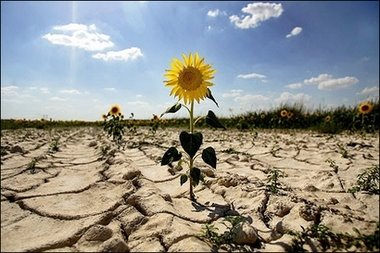
Sunflowers grow in a dry field in Spain during a drought. Wealthy nations are facing a water crisis mirroring the one experienced by drought-plagued poor countries, the environmental group WWF warned in a report.(AFP/File/Pedro Armestre)


Spain's Water Reserves Fall Further To 43.9 Percent

SPAIN: August 17, 2006

MADRID - Spain's reservoirs are now only 43.9 percent full, 1.4 points less than a week ago, the Environment Ministry said on Wednesday, showing that continuing drought and high temperatures were taking their toll.

Last year was the driest since records began, and the rain that fell over the winter and spring of this year was not enough to replenish reserves.
The 23,385 cubic hectometres of water now available compare with 23,866 in the same week last year and with an average for the past 10 years of 30,263 at the same date.

Regions in the south and east have the lowest reservoirs, while those in the northwest are mostly 60 to 70 percent full.

Irrigation water has been strictly rationed in parts of the country, which is likely to reduce the maize crop this year.

The power industry is also suffering from the shortage of rain. In a wet year 12 percent of Spain's electricity comes from hydroelectric plants, while in a bad year, like 2005, that fell to barely 8 percent.

Rain is forecast across the country on Thursday, but summer storms typically do little to replenish reserves.

REUTERS NEWS SERVICE

Other resources:

EU Helps Drought Stricken Spain/Portugal

Spain Braces For Second Year of Drought

Iberian Misery As Drought Bites
~~~~~~~~~
This will only get worse if we continue on this road.

Wednesday, August 16, 2006

Water News: Billions Face Shortages

Billions Face Shortages

We are wasting water like we are wasting oil and not thinking of the consequences.
We are not respecting the gifts we have been given.
We are making the wrong choices.
We are not thinking of the future...
Therefore, we are now at a point where just thinking about it isn't good enough.
It is time to do something about it.

China: Worst Water Crisis In The World-Part 1

Due to severe drought bordering on cataclysm, poor management of resources, severe pollution, and an economic boom that cannot keep up with water demand or population growth, China now faces the worst water crisis in the world.

According to a government report:

300 million Chinese drink unsafe water tainted by chemicals.

90% of China's cities have polluted ground water.


CHINA: August 14, 2006

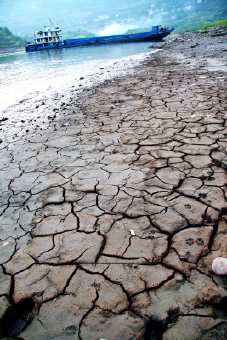
The dry river bed of the Changjiang River is seen in Yunyang county, southwest China's Chongqing Municipality August 12, 2006. More than 17 million people in southwest China's Chongqing Municipality and the neighbouring Sichuan province are tortured by serious lack of adequate drinking water due to continuous droughts and searing heat, Xinhua News Agency reported. Picture taken August 12, 2006.

Photo by CHINA DAILY
~~~~~~~~~~~~~~~~~~~~~~~~~~~~~~~~~~~~
And currently, 17 million people are without water because of drought.

17 Million Without Water

BEIJING (Reuters) - About 17 million people in southwest China don't have access to clean drinking water due to sustained drought, state media reported on Sunday.

Crops on large tracts of farmland in Sichuan province and the nearby Chongqing municipality have withered due to the month-long drought, causing economic losses of 9.23 billion yuan ($1.15 billion), the Beijing News and the Xinhua news agency said.

Local governments have allocated funds to help residents fight the drought by tapping ground water and improving water conservation facilities, Xinhua said.

The searing heat meant 14 million people in Chongqing and three million in Sichuan lack clean drinking water, the media said.

State television showed pictures of trucks transporting water to the worst-hit areas and villagers digging wells.

The water level in the Chongqing section of the Yangtze river -- China's longest river -- hit 3.5 metres (11.5 feet), its lowest in 100 years, the online edition of state broadcaster CCTV said.
~~~~~~~~~~~~~~~~~~~~~~~~~~~~~~~~~~~~~~~~~~~~~~~~~~~
Is this the price humans must pay for economic expansion and indifference to our environment? And is it the economic expansion causing this crisis, or the fact that those responsible for maintaning water supplies for the people are too irresponsible and greedy?

China's infrastructure is in abysmal condition even though it's leaders promised clean water to its people. It would appear that China faces a calamity of untold proportions brought on by its own desire to be number one. Where have we seen this before?

The problems that plague China's water supply have been doing so for years, but never on this scale as irresponsibility, poor planning, massive pollution, waste, and the effects of climate change all work in tandem to undermine the economic growth China is experiencing. And at whose expense is this growth that is being squandered? The people of China, the species that live there, and our global environment.

China Mulling Raising Prices on Oil, Energy, Water

The government is now looking to raise prices on oil, energy, and water in an attempt to curtail waste. However, is this an effective way to curtail waste? Or will it simply burden small businesses and consumers unfairly? And what of the severe pollution plaguing China's waterways? The article above claimed that people desperate for water are digging wells... to access groundwater that is already polluted. This simply cannot go on and be sustainable to the people of China.

Also See:

China, Worst Water Crisis In The World

Global Warming Behind Killer Typhoons In China

In my next entry I will write more about the drought facing China, the rivers that run through it, the fallout from pollution that threatens all life especially in light of this severe drought, and actions organizations are taking to alleviate the suffering of those whose lives hang in the balance.

Tuesday, August 15, 2006

Climate Change Effects In Asia

FACTBOX - Climate change predictions for Asia

Mon Aug 14,

Reuters - Asia, home to more than half the world's 6.3 billion people, could be badly affected by climate change, many experts warn, as the predicted rising sea levels, melting glaciers, droughts, floods, and food and water shortages take their toll.

Here is an overview of how climate change might affect Asia:

TROPICAL STORMS:

- The western Pacific already experiences more typhoons than any other part of the world. Scientists fear Asia will be hit by more frequent and severe storms, the U.S. Climate Institute says.

- While nations like Japan, Korea and Taiwan can afford better protection, others around the Bay of Bengal such as Bangladesh probably will not, and their flat, dense settlements already make them badly susceptible to cyclones.

RISING SEA LEVELS

- India and Bangladesh will have to draw up permanent relocation plans for millions of people as sea levels rise. Around 15 percent of Bangladesh would be under water if the sea level rose by a metre in the next century, a leading climatologist said last year. Japan's major coastal cities, and island nations are also threatened.

- Vietnam, Thailand, Indonesia, Cambodia and China, could suffer sharp cuts in their gross domestic product because of rising sea levels, the World Bank said in April 2006.

MELTING GLACIERS, SCARCE WATER

- Glaciers around the world have been retreating since the 1850s, as the climate has warmed. Around 67 percent of Asia's Himalayan glaciers in Nepal, west China and north India, are now melting more rapidly because of global warming, conservation group the WWF said in a March 2005 report.

- Their melting poses a major threat to the Indian subcontinent, Southeast Asia and parts of China, the Intergovernmental Panel on Climate Change (IPCC) says.

- Water scarcity will worsen because seven of Asia's main rivers, including the Ganges, Indus, Brahmaputra and the Mekong, begin in the Himalayas. Summer glacial meltwater is crucial to hundreds of millions of people downstream, who rely on it for irrigation and hydroelectric power.

- Asia already has 60 percent of the world's population but only 36 percent of the globe's freshwater, the UN World Food Programme has said.
DESERTIFICATION AND DROUGHTS

- Northern China, already threatened by the advance of Mongolia's Gobi desert, faces the further loss of arable land to desertification. Warmer winters and less rainfall make topsoil more susceptible to being blown away by strong winds.

- Over a quarter of China's huge landmass is classified as desert, and up to 400 million people are threatened by fast-advancing deserts, Greenpeace said in 2003.


EXTINCTION OF SPECIES

- Climate-related risks to Asia's rich array of species are climbing. As many as 1,250 of India's 15,000 higher plant species are threatened, and similar trends are evident in China, Malaysia, Myanmar, and Thailand, the IPCC said in 2001.

- Many of Asia's mammals and birds are likely to be wiped out because of the combined effects of climate change and habitat fragmentation, the IPCC says.

Sources: Reuters, IPCC, WWF, WFP, Greenpeace
~~~~~~~~~~~~~~~~~~~~~~~~
Do we have a moral obligation to do all we can to help mitigate this crisis? And is there not only one answer to this question? This problem isn't going away, and by our behavior contributing to these conditions, we are morally accountable for the effects of our actions. We do have what we need to alleviate the suffering of millions of people. Will we continue to allow politics to stand in our way? Or will we for once prove that human will is more important and stronger than political powerplaying? My next entry will be on the severe water crisis in China which has left millions without water.

Sunday, August 13, 2006

Can Clean Water Save Rwanda?

Can Clean Water Save Rwanda?

Water for People Initiative

The genocide in Rwanda that happened twelve years ago is still having an effect on the people of Rwanda regarding a devastating water crisis. The first link describes what it is doing to gorillas there as well as people. The second link announces an initiative by Water for People to
address the issue.

Rwanda: Prime Minister Calls For Water Security

So without political will, the people perish?

UNACCEPTABLE.

WE then have to take the initiative. The problem is, without rainfall, there is no source for water if what they have is drying up. That's how wars start, in expecting others to share what they have. And they say man is a "civilized" species. These people do not only need pumps, they need to learn how to MANAGE the resources they have. Drip irrigation, rainfall catchement, etc. To not provide this information to areas in the world that need it is just immoral.

Saturday, August 12, 2006

The Moreau River Is Dry

The Moreau River is a tributary of the Missouri River, approximately 200 miles long, in South Dakota in the United States. And due to intense drought, it is now dry.


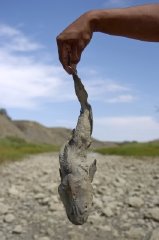
Photo by JONATHAN ERNST
A man holds up a catfish carcass in the dried-out Moreau River on the Cheyenne River Indian reservation near Thunder Butte, South Dakota August 7, 2006. A severe drought has killed crops, left ideal conditions for wildfires, forced ranchers to sell cattle and has evoked memories of the Dust Bowl disaster in the 1930s.

The Moreau River

And it isn't as though this isn't a known fact. This document mentions specifically that the Moreau River's water levels tend to coincide withe the Missouri River because of its shape. Therefore, considering there is such an intense drought currently exacerbating this condition, why aren't measures being taken to protect the life in this river? Not only is this drought effecting the water level, it is effecting the livelihoods of the people who live along this river, and the life in it that depends on it. I guess because it flows near a reservation the government doesn't really give a damn.

I'm looking into this, and more information will follow.

Heatwave Drying Up Europe's Water Resources

I have previously written at least twenty two entries regarding water and the coming shortages, which if not effectively managed will lead to war over this resource which is now becoming evermore precious due to the heatwave currently hitting many parts of our world. As the report below corroborates, drought and heat which is being caused by climate change is truly making a "planetary emergency", however, people don't seem to be too worked up over this.

Is it because they only see this as freshwater and are ignorant to the fact that it is a FINITE resource, and once it is gone it is gone? Desalinisation won't solve the problem, as it is costly, and would be hard to get water to interior areas of countries landlocked. CONSERVATION of the freshwater resources we have NOW as well as action to mitigate the conditions causing these droughts is what we must see GLOBALLY. As this article also points out for example, 70% of Spain's water is being wasted in irrigation. The EU MUST take URGENT steps to preserve the freshwater left to apportion it and manage it equitably, because should the rains not come in October or not be sufficient there will be an environmental catastrophe taking hold of untold proportions, and that isn't an exaggeration.

In writing about Kenya, I showed a picture of a dead calve who had been emaciated to the bone due to drought and heat. I didn't show the children emaciated to the bone, but they are there too. The people of Kenya risk their LIVES looking for water that is potable enough to drink, and they are losing their lives because of it. If you then think it can't happen in Europe, or in time even here, think again. And make no mistake about it, people WILL KILL FOR WATER. Lack of potable water causes food shortages, disease, and death, and it will cause war. Is this truly the way we wish to see this world go?As my last entry also spoke of, I also believe controlling water resources is one of the reasons for the current Israeli-Hezbollah war, and if you have been following it mention was made yesterday that it may cease once the Israelis reach the Littani River... That is because they are looking to control ALL the sources of water in that region because they know that water is a very precious commodity in the Middle East, and it is then the one way they can control the Palestinians and Lebanese. If they control the water, they can make those who they deem worthy to share it pay dearly for it.

I truly believe if that is one of the reasons why the Israeli government is doing this, that it is absolutely despicable and a human rights abuse. If they truly are withholding water from farmers, denying water to the people supplied by these rivers because of price gouging, and or diverting water to their own source from the Littani, Wazzani, or Jordan Rivers, it is a human rights abuse. Look what they did to the Mediterranean Sea by their bombing that caused 15 million tons of oil to spill into it. You can't even desalinate water that has been poisoned to that extent.

PEOPLE WILL DIE WITHOUT WATER.

However, we will see more of this as the years go by if the issues regarding water scarcity, management, and declaring it a HUMAN RIGHT internationally are not addressed NOW.
~~~~~~~~~~~~~~~~~~~~~~~~~~~~~~
The record temperatures in July have had a dramatic effect on Europe's water resources. Many lakes and rivers are at record lows, aggravating problems already caused by bad water management. The heat wave that has gripped Europe this summer has been breaking records across the continent. In Germany, dramatically high temperatures made this July the second hottest since 1901. A 1911 record for the highest July temperature in Britain was broken when a village in Surrey hit 36.5 degrees Celsius (97.7 degrees Fahrenheit). And the Dutch meteorological institute said this July was the hottest month in the Netherlands since temperatures were first measured in 1706.

Even though it has cooled down somewhat in the past few days, last month was still three-and-a-half degrees warmer than average, said Gerhard Müller-Westermaier, an expert in climate monitoring at Germany's National Meteorology Service. He said that the heat wave is part of global warming. "It fits the picture and it will continue to get warmer," Müller-Westermaier said. "We have had a warming of about 0.8 degrees since the beginning of the 20th century and the forecast says that in the next 100 years, we may have temperatures 1.5 to 5.5 degrees warmer. A summer like this one will become a normal summer."Drought hit agricultural sector hard."

Despite the many summer storms that swept across Germany, the country had less than 70 percent of the average July rainfall. This had a severe impact on the agricultural industry. In the eastern German state of Brandenburg, for example, farmers said their wheat yield was down some 40 to 50 percent. B

ildunterschrift: Großansicht des Bildes mit der Bildunterschrift:

German farmers feel the heat

According to Müller-Westermaier, more heat required more precipitation. But he said rainfall trends due to global warming have become more difficult to predict. "The models are not very good, but what they say up to now at least for central Europe is that especially in winter we will have more precipitation," Müller-Westermaier said. "In summer, there will be less precipitation. This is, of course, not a good forecast, so perhaps we will have to change our agricultural production in the future."EU needs to wake up to water problemsThe situation is even worse for farmers in the Mediterranean countries of France, Italy and Spain.

In the last year, reservoir levels in Spain have dropped to nearly half of their capacity, which is a clear indicator of drought. Climate change has exacerbated the problems caused by bad water management. Martin Geiger, the head of the Freshwater Program at environmental group WWF, said that in countries like Spain, more than 70 percent of water resources are used in agriculture -- and much of this is wasted. He said the European Union needed to wake up to how precious a resource water is.
~~~~~~~~~~~~~~~~~~~~~~~~~~~~~~~~~~~~~~

We ALL need to wake up to how precious a resource water is. People in America take it for granted. Fountains, pools, washing SUVs, over watering lawns, and blatantlu and slfishly wasting huge amounts of water daily will only bring us to a tipping point as water levels in rivers continue to go down as heat goes up and the precipitation to replace it is not here due to the climate crisis we face now. WHY is it that so many people don't seem to be able to grasp this concept and continue to go about their lives as if it doesn't effect them? We are reaping the whirlwind, and where it concerns our global water supply, we are playing with fire.
Another World Water Day Gone

We see another World Water Day pass us by. The theme, Water For All, signifies that though some progress has been made we are woefully behin...