Saturday, January 06, 2007

Drought Threat Casts Shadow On Agriculture

The one thing you can see from reading all of these entries, is that it doesn't matter in what part of the world you live in, people are the same when it comes to wasting natural resources. Countries are going to have to begin practicing more responsible water conservation if they are to survive. I do not believe this is just a fluke. This will be our way of life now, as we have allowed our greed and our dismissal of this problem to now escalate to a global crisis.


Drought Threat Casts Shadow On Agriculture

(04-01-2007)
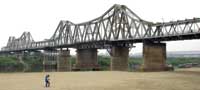
The water level of the Hong (Red River) has reduced to such an extent that local people can walk across the river bed. — VNA/VNS Photo Doan Tung

HA NOI — Relevant sectors and localities nationwide have begun implementing measures to fight droughts, forecast to occur on a large scale this year.

Nguyen Dinh Ninh, Deputy Director of the Water Resource Department, said El Nino would affect the whole country, but the southern-central area, Tay Nguyen (Central Highlands) and southern regions would be the worst hit with droughts predicted to get more serious than last year.

Water flow in the northern rivers was expected to come down by 15-50 per cent from the average rate, and in the lower part of Red River by as much as 30-50 per cent due to diverting water to the two major hydro-power plants of Hoa Binh and Thac Ba.

While rains, expected around this time in the central-southern area and western Truong Son mountain, have kept away, the drought could stretch to August if it doesn’t rain till April.
With the dry season having started last month, and expected to continue till May, 2007, water in the rivers in central, Tay Nguyen (Central Highlands) and southern regions was expected to come down by 20-40 per cent, increasing drought and salinity.

The many factors causing droughts include the increasing demand for water, shorter rainy season and longer dry season, and shortage of water for irrigation.

With about 200,000ha of winter-spring rice crop in the northern area facing water shortage, the Ministry of Agriculture and Rural Development has urged localities to check the volume of available water, and asked them to carry out rice transplant only in areas having enough water.
Localities have also been urged to closely manage water resources, prevent loss of water, especially in reservoirs, monitor salinity and store water from tides for the winter-spring rice crop.
~~~~~~~~
More at the link.

Also see:

Severe Drought Persists Throughout Vietnam

Southeast Asia Drought/Maps


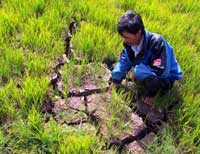
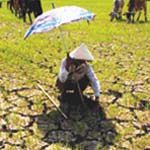
A farmer in Pleiku City examines her drought-plagued rice field.— VNA/VNS Photo Sy Huynh


Tens of hectares of rice in Ia Bang Commune in Gia Lai Province �s Dak Doa District have been damaged by severe drought. � VNA/VNS Photo Sy Huynh

Monday, January 01, 2007

A Century Later, Los Angeles Atones For Water Sins

Collusion and deception have been common practice regarding water resources for centuries. Hopefully, this will atone for the damage caused to Owens Valley.


A Century Later, Los Angeles Atones For Water Sins

By RANDAL C. ARCHIBOLD
Published: January 1, 2007

INDEPENDENCE, Calif. — It may fall short of a feel-good sequel to “Chinatown,” the movie based on the notorious, somewhat shady water grab by Los Angeles that allowed the city to bloom from a semi-arid desert.
Skip to next paragraph


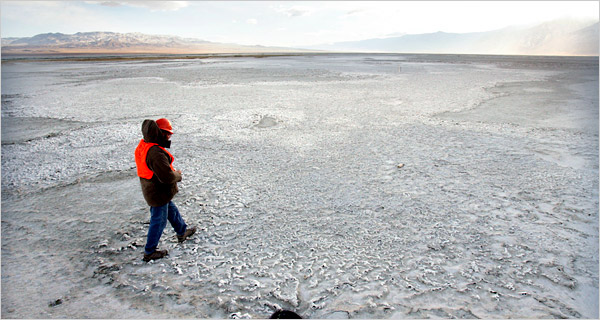
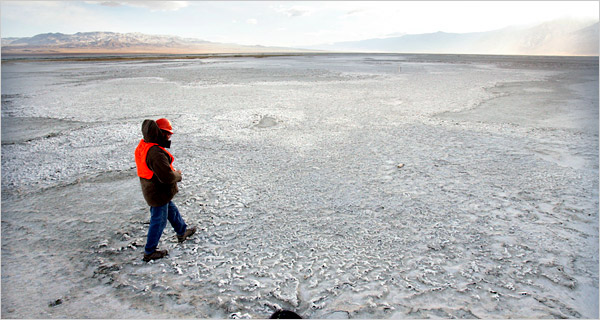
Mike Prather, an environmental advocate, walked a dry part of Owens Lake, which emptied when the Owens River was diverted to Los Angeles.
J. Emilio Flores for The New York Times


As part of a project to restore water to the Owens Valley, a dam redirects water going to Los Angeles, causing it to flow into the Owens River.

But in one of the largest river restoration efforts in the West, water is again flowing along a 62-mile stretch of the Owens River after a dry spell of nearly a century.

That part of the river had been left mostly drained when upstream water, fed by snowmelt from the towering Sierra Nevada, was channeled 233 miles south to fill swimming pools and bathtubs throughout Los Angeles.

The restored flow is among several long-awaited steps the city is taking to help make amends for the environmental consequences of its water maneuvering, most notably the drying up of Owens Lake, an area more than three times the size of Manhattan, here in the Owens Valley.
Los Angeles agreed in December to expand efforts to control toxic dust storms that erupt from what is left of the lake, a 110-square-mile body that emptied when the river was diverted to Los Angeles through an aqueduct opened in 1913.

The lake’s salty, mineral-laced basin has been the largest single source of particulate pollution in the country. It looks so otherworldly that it doubled as a desolate planet in the movie “Star Trek V: The Final Frontier.”

To restore the river, Los Angeles built automated gates at the point where the river veers into the aqueduct. The gates steer some water into the original riverbed, setting the stage for the growth of cottonwood trees and other plants and the return of waterfowl and other animals.
Much of the water eventually returns to the aqueduct, though some of it is being used for lake irrigation and other projects.

Environmentalists here say they are keeping an eye on Los Angeles for backsliding, but they acknowledge that the new efforts will make a significant difference.

More at the link.
~~~~~~~~~
More resources:

The Owens Valley Land Grab

Images of Owens Valley
You must look at these images to see the full extent of the damage done to this region.

Tuesday, December 26, 2006

African States Work To Share Nile Water


African States Work To Share Nile Water


By CHARLES J. HANLEY, AP Special Correspondent
Mon Dec 25, 11:34 AM ET

ENTEBBE, Uganda - After three years of closed-door talks, nine nations are quietly edging toward a deal to jointly oversee the waters of the Nile, an agreement that has eluded lands along the great river since the days of the pharaohs.

An expected meeting of water ministers next month may produce a preliminary accord, officials say. "I hope we'll reach a very good result, but I cannot guarantee it," Egyptian negotiator Abdel Fattah Metawie said in Cairo, the likely site for the session.

Such a pact would right a colonial-era wrong that reserved the world's longest river for irrigation in Egypt and Sudan, effectively denying its waters to Uganda and other upriver countries.

Nature may be pushing political leaders toward compromise, said Gordon Mumbo of the Nile Basin Initiative, an umbrella office here for joint activities among the riverine nations.
Drought and heat have lowered the level of nearby Lake Victoria, the vast lake that spills an outlet stream northward to start the Nile's 4,000-mile meander — from this region of jungle and crocodiles to the camel-crossed deserts of Egypt and the Mediterranean Sea.

"One of the greatest realizations is that the waters of the Nile of Lake Victoria are finite. They can be depleted," said Mumbo, a regional project manager. "The issue is how can people come together and best manage them today and tomorrow."

The long-term vision sees irrigated crops from central Africa feeding Egypt, for example, and Ethiopian dams supplying hydroelectric power across the region. Even millennia back, Egypt's pharaonic empire tried to push its rule south to ensure no one would block their Nile lifeline.

More at the link.
~~~~~~~~~~~~~~~~~
The Nile River is regarded as the longest river on Earth (flowing for 4000 miles) with two main tributaries, the Blue Nile and the White Nile flowing apart until the meet near Khartoum in Sudan. The northern section of the river flows from Sudan into Egypt, which has depended on the waters of the Nile since ancient times when pharoahs flooded the river to provide fertile soil and in return would receive the crops grown. Nearly all of the historical sites of Ancient Egypt are also seen along the banks of the Nile River which ends in a delta that empties into the Mediterranean Sea.

The source of the Nile is considered to be Lake Victoria, which also has rivers that feed into it from Rwanda, and Tanzania. This is known as the White Nile. The Blue Nile flows over eight hundred miles to Khartoum where the Blue Nile and White Nile join to form the "Nile proper". 90% of the water of the Nile originates in Ethiopia, but only in summer, when the rains fall on the Ethiopian Plateau. Otherwise, the rivers feed it weakly.

More History of the Nile River

There has also been much heated debate throughout history as how to best maintain the waters of the Nile River in an equitable fashion.

The Nile River: Building or Stumbling Block?

Is there hope now? Well, as the article above makes clear, circumstances are such that those nations involved will have no choice, as UN experts say populations in the river basin may double by mid-century and that scenarios show global warming decreasing water flows in the Nile by up to 40 percent.

Nile Basin Initiative
The Nile Basin Initiative shares a vision that those resources can be managed without conflict. Let us hope that is a reality.

Also see my entry:

Water Levels In Lake Victoria Dropping Fast

Tuesday, December 19, 2006

2006-International Year Of The Desert

International Year of The Desert

Desertification, in the words of UN Secretary-General Kofi Annan, is one of the world’s most alarming processes of environmental degradation. The issue is often obscured, however, by a common misperception: that it’s a “natural” problem of advancing deserts in faraway developing countries. In fact, Desertification is about land degradation: the loss of the land’s biological productivity, caused by human-induced factors and climate change. It affects one third of the earth’s surface and over a billion people. Moreover, it has potentially devastating consequences in terms of social and economic costs.


Desertification and International Policy Imperative

This is information about the desertification conference held in Algiers that just ended today. I will be posting on the outcome when more information is known.

Battling The Desert In China

Main causes of drylands/deforestation

*climate change from the burning of fossil fuels causing less rainfall and over evaporation of the soil
* over population
* over grazing
* overusing groundwater
* deforestation/destroying trees
* the use of wood as domestic fuel
* growing water intensive crops (like rice)

These are all actions that can be reversed by humans taking the initiative, which will be the only course of action as this crisis worsens.

Sunday, December 17, 2006

Better Farming Urged To Limit Deserts, Refugees

Better Farming Urged To Limit Deserts, Refugees

By Alister Doyle, Environment Correspondent

OSLO (Reuters) - Desertification could create millions of refugees unless governments promote less water-intensive farming and new jobs ranging from solar energy to eco-tourism, U.N. experts said on Thursday.

They said many of the world's drylands, home to 2 billion people and including many crop regions from Africa to Australia, were under threat of turning to dust, in part because of a global warming widely blamed on human use of fossil fuels.

"Bad policies are as much to blame for aggravating desertification as climate change," said Zafar Adeel, head of the U.N. University's Canada-based International Network on Water, Environment and Health.

About 200 experts from 25 nations will meet in Algiers on Dec. 17-19 to try to advise on new policies to slow the spread of deserts, which now cover about a quarter of the world's land surface from the Sahara to the Gobi.

Conference organiser Adeel told Reuters 10-20 percent of drylands are already degraded, affecting almost 200 million people. Some estimates say 135 million people are at risk of being driven from their homes by desertification.

"If millions of people with skills as farmers suddenly find themselves living in desertified areas ... they have no time to adapt and have to flee," Janos Bogardi, head of the U.N. University's Institute for Environment and Human Security in Bonn, told Reuters.

New policies could include helping people whose lands are at risk from erosion to plant more drought-resistant crops or turn to new activities such as eco-tourism, fish farming or production of solar energy.

CROPS, FERTILISERS

One idea was to encourage poor people in rural areas to stop traditional burning of crop residues and animal dung for fuel, shifting to wind or solar energy. Crop residues and dung could then be used as fertiliser, slowing desertification.

"We need to have innovative solutions," Adeel said, adding that governments would have to come up with more money.

Bogardi estimated the number of people driven from their homes mainly by environmental causes already exceeded the world's 20 million political refugees. It was hard to judge because there is no category of "environmental refugee".

Governments could consider investing in solar panels to let farmers sell power as an alternative livelihood in sunny, arid regions. Even parts of southern Spain were more suitable for producing solar power than for growing water-intensive crops.

Too often farmers tried to offset degradation of drylands by ever more costly irrigation rather than switching to less water-demanding activities.

"Crops transpire water. It's a very water-intensive process," Adeel said. He added that fish farming -- such as in Egypt, Pakistan or Israel -- was a way of producing food without such heavy water use.

And tourism could also earn money for people on the fringes of deserts, as long as it did not waste valuable water. "Tourists should not expect golf courses or green lawns but be happy seeing cactus gardens," Bogardi said.© Reuters 2006. All Rights Reserved.

~~~~~~~
There needs to be a WORLDWIDE drought summit next year apart from the one mentioned in this article, in which bold and firm resolutions are set forth to help countries deal with a global drought that is now not just to be considered indigenous or sporadic.

Drought is now more pervasive, more sustained, more destructive, more costly, and more deadly than ever before. Along with the destruction of our oceans, drought is the most crucial environmental crisis we now face because it leads to lack of water and food shortages that millions of people depend on for life.

And climate change is oneof the chief causes for this desertification, along with wasteful corrupt practices regarding water management that must be changed with governments that do not take it upon themselves to push for conservation and more innovative farming management and methods being penalized for it.

And linked to that are the concerns raised in the article above surrounding bad policies regarding farming and the waste that comes from it. And as I have stated before, SOLAR energy is what will save Africa, and they need it NOW.

Other forms of irrigation include:

Drip irrigation

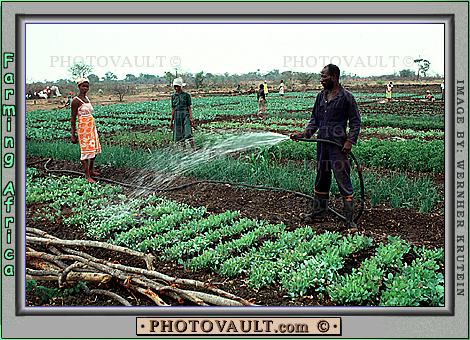
Irrigation in Africa:

Look at this picture from the link above. What is wrong with it?


This entry is a work in progress and more information will be added to it on an ongoing basis for the next week.

For reference:
World Water Council/Drought Preparedness

Thursday, December 14, 2006

Satellites Weigh Africa's Water


Satellites Weigh Africa's Water


By Jonathan Amos Science reporter, BBC News, San Francisco

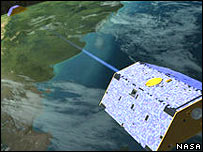
Photo above:
The Grace twins weigh the changes in the storage of water on land.

Africa has experienced a significant drying in the past three years, new satellite data reveals.
The volume of water lost from the land amounts to 334 cubic km, which is almost as much as all Africans have consumed over the period.

The data comes from Nasa spacecraft that can detect changes in gravity caused by water as it cycles between the sea, the atmosphere and the land.

Experts stress no firm conclusions should be drawn from the short study. Professor Jay Famiglietti from the University of California-Irvine said much longer times series were needed to detect real trends and any signal that might indicate a significant shift in climate. "There are natural climate variations, the natural ups and downs," he explained.

"Another big factor is human control of the water cycle - reservoir management, the storage of water on continents. "Groundwater mining leads to heavy depletions of water. Wetland drainage, river diversion projects - all of those factors contribute to these storage variations that we see and we'll be working on trying to sort those out over the next few years," he told the BBC.
More at the link.
~~~~~~~~

Sunday, December 10, 2006

Water Levels In Lake Victoria Dropping Fast

Water Levels In African Lake Dropping fast

Excerpt:

By CHARLES J. HANLEY, AP Special Correspondent
Sat Dec 9, 1:12 PM ET

JINJA, Uganda - At Jinja pier the rusty red hull of a Lake Victoria freighter sat barely afloat in water just six feet deep — and dropping. "The scientists have to explain this," said ship's engineer Gabriel Maziku.

Across the bay, at a fish packing plant, fishermen had to wade ashore with their Nile perch in flat-bottomed boats, and heave the silvery catch up to a jetty that soon may be on dry land and out of reach entirely. Looking on, plant manager Ravee Ramanujam wondered about what's to come.

"Such a large body of water, dropping so fast," he said.

At 27,000 square miles, the size of Ireland, Victoria is the greatest of Africa's Great Lakes — the biggest freshwater body after Lake Superior. And it has dropped fast, at least six feet in the past three years, and by as much as a half-inch a day this year before November rains stabilized things.

The outflow through two hydroelectric dams at Jinja is part of the problem — a tiny part, says the Uganda government, or half the problem, say environmentalists. But much of what is happening to Victoria and other lakes across the heart of Africa is attributable to years of drought and rising temperatures, conditions that starve the lakes of inflowing water and evaporate more of the water they have.

An extreme example lies 1,500 miles northwest of here, deeper in the drought zone, where Lake Chad, once the world's sixth-largest, has shrunk to 2 percent of its 1960s size. And the African map abounds with other, less startling examples, from Lake Turkana in northern Kenya, getting half the inflow it once did, to the great Lake Tanganyika south of here, whose level dropped over five feet in five years.

"All these lakes are extremely sensitive to climate change," the U.N. Environment Program warned in a global water assessment two years ago.

Now, in a yet unpublished report obtained by The Associated Press, an international consulting firm advises the Ugandan government that supercomputer models of global-warming scenarios for Lake Victoria "raise alarming concerns" about its future and that of the Nile River, which begins its 4,100-mile northward journey here at Jinja.

The report, by U.S.-based Water Resources and Energy Management International, says rising temperatures may evaporate up to half the lake's normal inflow from rainfall and rivers, with "severe consequences for the lake and its ability to meet the region's water resources needs."

A further dramatic drop in Victoria's water levels might even turn off this spigot for the Nile, a lifeline for more than 100 million Egyptians, Sudanese and others.

"People talk about the snows of Kilimanjaro," said Aris P. Georgakakos, the study's chief author, speaking of that African mountain's melting glaciers. "We have something much bigger to worry about, and that's Lake Victoria."

Each troubled lake is a complex story.

Lake Chad's near-disappearance, for example, stems in part from overuse of its source waters for irrigation. Deforestation around Lake Victoria, shared by Uganda, Kenya and Tanzania, makes the area a less efficient rain "catchment" for the lake, and overfishing and pollution are damaging its $400-million-a-year fishing industry. Kenya's Rift Valley lakes, some just a few feet deep, have always fluctuated in size, even drying up with drought.

But African leaders say things are different this time, because long-term climate change may eclipse other factors.

"These cycles, when they've happened, they haven't happened under the circumstances pertaining now — the global warming, overpopulation, degradation," said Maria Mutagamba, Uganda's water and environment minister.

End of excerpt.
~~~~~~~~
Lake Victoria-Kenya

The Falling Waters Of Lake Victoria
Courtesy of NASA

Lake Victoria Project
Take a look at how the people in this region are caring for the ecosystems of the lake and involving children in this process.

UN Accuses Uganda Of Draining Lake Victoria

And now see how adults will continue to negate these good efforts:
Independent, The (London), Feb 9, 2006 by Tristan McConnell in Kampala

The United Nations has accused Uganda of draining Lake Victoria to maintain its electricity supplies, despite an impending environmental catastrophe as water levels in Africa's largest lake drop to their lowest in 80 years.

The water is three metres below its normal level, leaving the jetties where pleasure boats moor and the landing sites where fishermen sell their catch high above the water.

The falling water level is affecting 30 million people in Uganda, Tanzania and Kenya whose livelihoods depend on the lake. As the waters recede silt and vegetation are encroaching on the lake and goats nibble the green shoots where fish once swam in the shallows. Sudan and Egypt, both of which rely on the river Nile, which runs out of Lake Victoria, for their water supply and for agricultural irrigation, will also be affected. In October last year the UN warned African lakes were the worst affected by climate changes.
~~~~~~~~~~~~~~~~
The need for education regarding climate change is crucial in Africa. And of course, related to that is accountability for water diverted away from people who need it. Dams only cause problems related to water flow and environmental damage, and in essence create the very gases we need to reign in to mitigate the droughts being experienced in almost 40% of this world. The people of this region need alternate ways to create electricity, such as solar power. It is IMPERATIVE in order to maintain equality in water distribution and to help ensure that levels do not go any lower.

How much more of this will have to be reported on before we get it? This is a global catastrophe in the making unless we act now in order to provide developing countries with alternate energy sources to lift pressure off of water resources! And the key to this really is overpopulation and education that seeks to address this crisis at the roots. When is the world going to tackle this on a level that truly addresses the underlying problems as a whole instead of just putting bandaids on it? And that includes the UN. We are making our planet unsustainable for human life. Shouldn't that be enough to know to move us?
Another World Water Day Gone

We see another World Water Day pass us by. The theme, Water For All, signifies that though some progress has been made we are woefully behin...