International Year of The Desert
Desertification, in the words of UN Secretary-General Kofi Annan, is one of the world’s most alarming processes of environmental degradation. The issue is often obscured, however, by a common misperception: that it’s a “natural” problem of advancing deserts in faraway developing countries. In fact, Desertification is about land degradation: the loss of the land’s biological productivity, caused by human-induced factors and climate change. It affects one third of the earth’s surface and over a billion people. Moreover, it has potentially devastating consequences in terms of social and economic costs.
Desertification and International Policy Imperative
This is information about the desertification conference held in Algiers that just ended today. I will be posting on the outcome when more information is known.
Battling The Desert In China
Main causes of drylands/deforestation
*climate change from the burning of fossil fuels causing less rainfall and over evaporation of the soil
* over population
* over grazing
* overusing groundwater
* deforestation/destroying trees
* the use of wood as domestic fuel
* growing water intensive crops (like rice)
These are all actions that can be reversed by humans taking the initiative, which will be the only course of action as this crisis worsens.
Tuesday, December 19, 2006


Sunday, December 17, 2006
Better Farming Urged To Limit Deserts, Refugees
Better Farming Urged To Limit Deserts, Refugees
By Alister Doyle, Environment Correspondent
OSLO (Reuters) - Desertification could create millions of refugees unless governments promote less water-intensive farming and new jobs ranging from solar energy to eco-tourism, U.N. experts said on Thursday.
They said many of the world's drylands, home to 2 billion people and including many crop regions from Africa to Australia, were under threat of turning to dust, in part because of a global warming widely blamed on human use of fossil fuels.
"Bad policies are as much to blame for aggravating desertification as climate change," said Zafar Adeel, head of the U.N. University's Canada-based International Network on Water, Environment and Health.
About 200 experts from 25 nations will meet in Algiers on Dec. 17-19 to try to advise on new policies to slow the spread of deserts, which now cover about a quarter of the world's land surface from the Sahara to the Gobi.
Conference organiser Adeel told Reuters 10-20 percent of drylands are already degraded, affecting almost 200 million people. Some estimates say 135 million people are at risk of being driven from their homes by desertification.
"If millions of people with skills as farmers suddenly find themselves living in desertified areas ... they have no time to adapt and have to flee," Janos Bogardi, head of the U.N. University's Institute for Environment and Human Security in Bonn, told Reuters.
New policies could include helping people whose lands are at risk from erosion to plant more drought-resistant crops or turn to new activities such as eco-tourism, fish farming or production of solar energy.
CROPS, FERTILISERS
One idea was to encourage poor people in rural areas to stop traditional burning of crop residues and animal dung for fuel, shifting to wind or solar energy. Crop residues and dung could then be used as fertiliser, slowing desertification.
"We need to have innovative solutions," Adeel said, adding that governments would have to come up with more money.
Bogardi estimated the number of people driven from their homes mainly by environmental causes already exceeded the world's 20 million political refugees. It was hard to judge because there is no category of "environmental refugee".
Governments could consider investing in solar panels to let farmers sell power as an alternative livelihood in sunny, arid regions. Even parts of southern Spain were more suitable for producing solar power than for growing water-intensive crops.
Too often farmers tried to offset degradation of drylands by ever more costly irrigation rather than switching to less water-demanding activities.
"Crops transpire water. It's a very water-intensive process," Adeel said. He added that fish farming -- such as in Egypt, Pakistan or Israel -- was a way of producing food without such heavy water use.
And tourism could also earn money for people on the fringes of deserts, as long as it did not waste valuable water. "Tourists should not expect golf courses or green lawns but be happy seeing cactus gardens," Bogardi said.© Reuters 2006. All Rights Reserved.
~~~~~~~
There needs to be a WORLDWIDE drought summit next year apart from the one mentioned in this article, in which bold and firm resolutions are set forth to help countries deal with a global drought that is now not just to be considered indigenous or sporadic.
Drought is now more pervasive, more sustained, more destructive, more costly, and more deadly than ever before. Along with the destruction of our oceans, drought is the most crucial environmental crisis we now face because it leads to lack of water and food shortages that millions of people depend on for life.
And climate change is oneof the chief causes for this desertification, along with wasteful corrupt practices regarding water management that must be changed with governments that do not take it upon themselves to push for conservation and more innovative farming management and methods being penalized for it.
And linked to that are the concerns raised in the article above surrounding bad policies regarding farming and the waste that comes from it. And as I have stated before, SOLAR energy is what will save Africa, and they need it NOW.
Other forms of irrigation include:
Drip irrigation
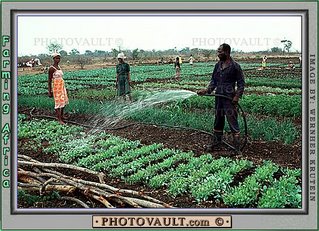
Irrigation in Africa:
Look at this picture from the link above. What is wrong with it?
This entry is a work in progress and more information will be added to it on an ongoing basis for the next week.
For reference:
World Water Council/Drought Preparedness
By Alister Doyle, Environment Correspondent
OSLO (Reuters) - Desertification could create millions of refugees unless governments promote less water-intensive farming and new jobs ranging from solar energy to eco-tourism, U.N. experts said on Thursday.
They said many of the world's drylands, home to 2 billion people and including many crop regions from Africa to Australia, were under threat of turning to dust, in part because of a global warming widely blamed on human use of fossil fuels.
"Bad policies are as much to blame for aggravating desertification as climate change," said Zafar Adeel, head of the U.N. University's Canada-based International Network on Water, Environment and Health.
About 200 experts from 25 nations will meet in Algiers on Dec. 17-19 to try to advise on new policies to slow the spread of deserts, which now cover about a quarter of the world's land surface from the Sahara to the Gobi.
Conference organiser Adeel told Reuters 10-20 percent of drylands are already degraded, affecting almost 200 million people. Some estimates say 135 million people are at risk of being driven from their homes by desertification.
"If millions of people with skills as farmers suddenly find themselves living in desertified areas ... they have no time to adapt and have to flee," Janos Bogardi, head of the U.N. University's Institute for Environment and Human Security in Bonn, told Reuters.
New policies could include helping people whose lands are at risk from erosion to plant more drought-resistant crops or turn to new activities such as eco-tourism, fish farming or production of solar energy.
CROPS, FERTILISERS
One idea was to encourage poor people in rural areas to stop traditional burning of crop residues and animal dung for fuel, shifting to wind or solar energy. Crop residues and dung could then be used as fertiliser, slowing desertification.
"We need to have innovative solutions," Adeel said, adding that governments would have to come up with more money.
Bogardi estimated the number of people driven from their homes mainly by environmental causes already exceeded the world's 20 million political refugees. It was hard to judge because there is no category of "environmental refugee".
Governments could consider investing in solar panels to let farmers sell power as an alternative livelihood in sunny, arid regions. Even parts of southern Spain were more suitable for producing solar power than for growing water-intensive crops.
Too often farmers tried to offset degradation of drylands by ever more costly irrigation rather than switching to less water-demanding activities.
"Crops transpire water. It's a very water-intensive process," Adeel said. He added that fish farming -- such as in Egypt, Pakistan or Israel -- was a way of producing food without such heavy water use.
And tourism could also earn money for people on the fringes of deserts, as long as it did not waste valuable water. "Tourists should not expect golf courses or green lawns but be happy seeing cactus gardens," Bogardi said.© Reuters 2006. All Rights Reserved.
~~~~~~~
There needs to be a WORLDWIDE drought summit next year apart from the one mentioned in this article, in which bold and firm resolutions are set forth to help countries deal with a global drought that is now not just to be considered indigenous or sporadic.
Drought is now more pervasive, more sustained, more destructive, more costly, and more deadly than ever before. Along with the destruction of our oceans, drought is the most crucial environmental crisis we now face because it leads to lack of water and food shortages that millions of people depend on for life.
And climate change is oneof the chief causes for this desertification, along with wasteful corrupt practices regarding water management that must be changed with governments that do not take it upon themselves to push for conservation and more innovative farming management and methods being penalized for it.
And linked to that are the concerns raised in the article above surrounding bad policies regarding farming and the waste that comes from it. And as I have stated before, SOLAR energy is what will save Africa, and they need it NOW.
Other forms of irrigation include:
Drip irrigation
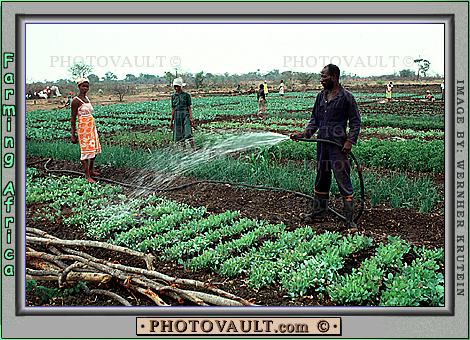
Irrigation in Africa:
Look at this picture from the link above. What is wrong with it?
This entry is a work in progress and more information will be added to it on an ongoing basis for the next week.
For reference:
World Water Council/Drought Preparedness
Thursday, December 14, 2006
Satellites Weigh Africa's Water
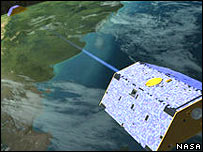
Satellites Weigh Africa's Water
By Jonathan Amos Science reporter, BBC News, San Francisco
Photo above:
The Grace twins weigh the changes in the storage of water on land.
Africa has experienced a significant drying in the past three years, new satellite data reveals.
The volume of water lost from the land amounts to 334 cubic km, which is almost as much as all Africans have consumed over the period.
The data comes from Nasa spacecraft that can detect changes in gravity caused by water as it cycles between the sea, the atmosphere and the land.
Experts stress no firm conclusions should be drawn from the short study. Professor Jay Famiglietti from the University of California-Irvine said much longer times series were needed to detect real trends and any signal that might indicate a significant shift in climate. "There are natural climate variations, the natural ups and downs," he explained.
"Another big factor is human control of the water cycle - reservoir management, the storage of water on continents. "Groundwater mining leads to heavy depletions of water. Wetland drainage, river diversion projects - all of those factors contribute to these storage variations that we see and we'll be working on trying to sort those out over the next few years," he told the BBC.
More at the link.
~~~~~~~~
Sunday, December 10, 2006
Water Levels In Lake Victoria Dropping Fast
Water Levels In African Lake Dropping fast
Excerpt:
By CHARLES J. HANLEY, AP Special Correspondent
Sat Dec 9, 1:12 PM ET
JINJA, Uganda - At Jinja pier the rusty red hull of a Lake Victoria freighter sat barely afloat in water just six feet deep — and dropping. "The scientists have to explain this," said ship's engineer Gabriel Maziku.
Across the bay, at a fish packing plant, fishermen had to wade ashore with their Nile perch in flat-bottomed boats, and heave the silvery catch up to a jetty that soon may be on dry land and out of reach entirely. Looking on, plant manager Ravee Ramanujam wondered about what's to come.
"Such a large body of water, dropping so fast," he said.
At 27,000 square miles, the size of Ireland, Victoria is the greatest of Africa's Great Lakes — the biggest freshwater body after Lake Superior. And it has dropped fast, at least six feet in the past three years, and by as much as a half-inch a day this year before November rains stabilized things.
The outflow through two hydroelectric dams at Jinja is part of the problem — a tiny part, says the Uganda government, or half the problem, say environmentalists. But much of what is happening to Victoria and other lakes across the heart of Africa is attributable to years of drought and rising temperatures, conditions that starve the lakes of inflowing water and evaporate more of the water they have.
An extreme example lies 1,500 miles northwest of here, deeper in the drought zone, where Lake Chad, once the world's sixth-largest, has shrunk to 2 percent of its 1960s size. And the African map abounds with other, less startling examples, from Lake Turkana in northern Kenya, getting half the inflow it once did, to the great Lake Tanganyika south of here, whose level dropped over five feet in five years.
"All these lakes are extremely sensitive to climate change," the U.N. Environment Program warned in a global water assessment two years ago.
Now, in a yet unpublished report obtained by The Associated Press, an international consulting firm advises the Ugandan government that supercomputer models of global-warming scenarios for Lake Victoria "raise alarming concerns" about its future and that of the Nile River, which begins its 4,100-mile northward journey here at Jinja.
The report, by U.S.-based Water Resources and Energy Management International, says rising temperatures may evaporate up to half the lake's normal inflow from rainfall and rivers, with "severe consequences for the lake and its ability to meet the region's water resources needs."
A further dramatic drop in Victoria's water levels might even turn off this spigot for the Nile, a lifeline for more than 100 million Egyptians, Sudanese and others.
"People talk about the snows of Kilimanjaro," said Aris P. Georgakakos, the study's chief author, speaking of that African mountain's melting glaciers. "We have something much bigger to worry about, and that's Lake Victoria."
Each troubled lake is a complex story.
Lake Chad's near-disappearance, for example, stems in part from overuse of its source waters for irrigation. Deforestation around Lake Victoria, shared by Uganda, Kenya and Tanzania, makes the area a less efficient rain "catchment" for the lake, and overfishing and pollution are damaging its $400-million-a-year fishing industry. Kenya's Rift Valley lakes, some just a few feet deep, have always fluctuated in size, even drying up with drought.
But African leaders say things are different this time, because long-term climate change may eclipse other factors.
"These cycles, when they've happened, they haven't happened under the circumstances pertaining now — the global warming, overpopulation, degradation," said Maria Mutagamba, Uganda's water and environment minister.
End of excerpt.
~~~~~~~~
Lake Victoria-Kenya
The Falling Waters Of Lake Victoria
Courtesy of NASA
Lake Victoria Project
Take a look at how the people in this region are caring for the ecosystems of the lake and involving children in this process.
UN Accuses Uganda Of Draining Lake Victoria
And now see how adults will continue to negate these good efforts:
Independent, The (London), Feb 9, 2006 by Tristan McConnell in Kampala
The United Nations has accused Uganda of draining Lake Victoria to maintain its electricity supplies, despite an impending environmental catastrophe as water levels in Africa's largest lake drop to their lowest in 80 years.
The water is three metres below its normal level, leaving the jetties where pleasure boats moor and the landing sites where fishermen sell their catch high above the water.
The falling water level is affecting 30 million people in Uganda, Tanzania and Kenya whose livelihoods depend on the lake. As the waters recede silt and vegetation are encroaching on the lake and goats nibble the green shoots where fish once swam in the shallows. Sudan and Egypt, both of which rely on the river Nile, which runs out of Lake Victoria, for their water supply and for agricultural irrigation, will also be affected. In October last year the UN warned African lakes were the worst affected by climate changes.
~~~~~~~~~~~~~~~~
The need for education regarding climate change is crucial in Africa. And of course, related to that is accountability for water diverted away from people who need it. Dams only cause problems related to water flow and environmental damage, and in essence create the very gases we need to reign in to mitigate the droughts being experienced in almost 40% of this world. The people of this region need alternate ways to create electricity, such as solar power. It is IMPERATIVE in order to maintain equality in water distribution and to help ensure that levels do not go any lower.
How much more of this will have to be reported on before we get it? This is a global catastrophe in the making unless we act now in order to provide developing countries with alternate energy sources to lift pressure off of water resources! And the key to this really is overpopulation and education that seeks to address this crisis at the roots. When is the world going to tackle this on a level that truly addresses the underlying problems as a whole instead of just putting bandaids on it? And that includes the UN. We are making our planet unsustainable for human life. Shouldn't that be enough to know to move us?
Excerpt:
By CHARLES J. HANLEY, AP Special Correspondent
Sat Dec 9, 1:12 PM ET
JINJA, Uganda - At Jinja pier the rusty red hull of a Lake Victoria freighter sat barely afloat in water just six feet deep — and dropping. "The scientists have to explain this," said ship's engineer Gabriel Maziku.
Across the bay, at a fish packing plant, fishermen had to wade ashore with their Nile perch in flat-bottomed boats, and heave the silvery catch up to a jetty that soon may be on dry land and out of reach entirely. Looking on, plant manager Ravee Ramanujam wondered about what's to come.
"Such a large body of water, dropping so fast," he said.
At 27,000 square miles, the size of Ireland, Victoria is the greatest of Africa's Great Lakes — the biggest freshwater body after Lake Superior. And it has dropped fast, at least six feet in the past three years, and by as much as a half-inch a day this year before November rains stabilized things.
The outflow through two hydroelectric dams at Jinja is part of the problem — a tiny part, says the Uganda government, or half the problem, say environmentalists. But much of what is happening to Victoria and other lakes across the heart of Africa is attributable to years of drought and rising temperatures, conditions that starve the lakes of inflowing water and evaporate more of the water they have.
An extreme example lies 1,500 miles northwest of here, deeper in the drought zone, where Lake Chad, once the world's sixth-largest, has shrunk to 2 percent of its 1960s size. And the African map abounds with other, less startling examples, from Lake Turkana in northern Kenya, getting half the inflow it once did, to the great Lake Tanganyika south of here, whose level dropped over five feet in five years.
"All these lakes are extremely sensitive to climate change," the U.N. Environment Program warned in a global water assessment two years ago.
Now, in a yet unpublished report obtained by The Associated Press, an international consulting firm advises the Ugandan government that supercomputer models of global-warming scenarios for Lake Victoria "raise alarming concerns" about its future and that of the Nile River, which begins its 4,100-mile northward journey here at Jinja.
The report, by U.S.-based Water Resources and Energy Management International, says rising temperatures may evaporate up to half the lake's normal inflow from rainfall and rivers, with "severe consequences for the lake and its ability to meet the region's water resources needs."
A further dramatic drop in Victoria's water levels might even turn off this spigot for the Nile, a lifeline for more than 100 million Egyptians, Sudanese and others.
"People talk about the snows of Kilimanjaro," said Aris P. Georgakakos, the study's chief author, speaking of that African mountain's melting glaciers. "We have something much bigger to worry about, and that's Lake Victoria."
Each troubled lake is a complex story.
Lake Chad's near-disappearance, for example, stems in part from overuse of its source waters for irrigation. Deforestation around Lake Victoria, shared by Uganda, Kenya and Tanzania, makes the area a less efficient rain "catchment" for the lake, and overfishing and pollution are damaging its $400-million-a-year fishing industry. Kenya's Rift Valley lakes, some just a few feet deep, have always fluctuated in size, even drying up with drought.
But African leaders say things are different this time, because long-term climate change may eclipse other factors.
"These cycles, when they've happened, they haven't happened under the circumstances pertaining now — the global warming, overpopulation, degradation," said Maria Mutagamba, Uganda's water and environment minister.
End of excerpt.
~~~~~~~~
Lake Victoria-Kenya
The Falling Waters Of Lake Victoria
Courtesy of NASA
Lake Victoria Project
Take a look at how the people in this region are caring for the ecosystems of the lake and involving children in this process.
UN Accuses Uganda Of Draining Lake Victoria
And now see how adults will continue to negate these good efforts:
Independent, The (London), Feb 9, 2006 by Tristan McConnell in Kampala
The United Nations has accused Uganda of draining Lake Victoria to maintain its electricity supplies, despite an impending environmental catastrophe as water levels in Africa's largest lake drop to their lowest in 80 years.
The water is three metres below its normal level, leaving the jetties where pleasure boats moor and the landing sites where fishermen sell their catch high above the water.
The falling water level is affecting 30 million people in Uganda, Tanzania and Kenya whose livelihoods depend on the lake. As the waters recede silt and vegetation are encroaching on the lake and goats nibble the green shoots where fish once swam in the shallows. Sudan and Egypt, both of which rely on the river Nile, which runs out of Lake Victoria, for their water supply and for agricultural irrigation, will also be affected. In October last year the UN warned African lakes were the worst affected by climate changes.
~~~~~~~~~~~~~~~~
The need for education regarding climate change is crucial in Africa. And of course, related to that is accountability for water diverted away from people who need it. Dams only cause problems related to water flow and environmental damage, and in essence create the very gases we need to reign in to mitigate the droughts being experienced in almost 40% of this world. The people of this region need alternate ways to create electricity, such as solar power. It is IMPERATIVE in order to maintain equality in water distribution and to help ensure that levels do not go any lower.
How much more of this will have to be reported on before we get it? This is a global catastrophe in the making unless we act now in order to provide developing countries with alternate energy sources to lift pressure off of water resources! And the key to this really is overpopulation and education that seeks to address this crisis at the roots. When is the world going to tackle this on a level that truly addresses the underlying problems as a whole instead of just putting bandaids on it? And that includes the UN. We are making our planet unsustainable for human life. Shouldn't that be enough to know to move us?
Saturday, December 02, 2006
Ten Years To Solve Water Crisis

Ten Years To Solve Water Crisis
Ten years to cure 'water crisis'
The plan advocates allowances for water use and meteringBritain's water systems are in crisis and the government has a decade to put things right, according to a coalition of conservation and angling groups.
They are setting out a 10-point plan to make UK water systems sustainable, including fair pricing, slashing waste and upgrading sewerage facilities.
People should have personal allowances and homes should be metered, they say. EU regulations require member nations to have plans for restoring natural watercourses in place by 2009.
The European Water Framework Directive prescribes that the ecology of rivers, lakes and wetlands should be restored by 2015.
For too long, we've taken water for granted
Fiona Reynolds, National Trust
"This is a once-in-a-generation opportunity," the coalition's report announces.
"With the Blueprint for Water we, a coalition of leading environmental organisations representing some six million people, are calling on the government to act now."
Going with the flow
It is perhaps unusual to find conservation groups such as the Wildlife Trusts, WWF and the RSPB in league with angling associations.
But on water, they find common arguments, namely that Britain should:
waste less water
keep rivers flowing and wetlands wet by barring damaging abstraction
price water fairly
stop pollutants entering watercourses and make polluters pay
upgrade sewerage and drainage systems to avoid fouling of human population centres and sensitive ecological areas
support water-friendly farming
restore and maintain rivers, wetlands and floodplains
"It's clear that adequate supplies of clean water are essential, not only for our lives but for the health of the habitats, species, landscapes and soils we depend on," said Fiona Reynolds, Director-General of the National Trust.
More at the link
Calculate your water usage here:
Water Calculator
~~~~~~~~~~~~~
Are we hopefully, finally realizing just how precious our water is? We have time to fix this. We can, and we must. And those suggestions above do not just apply to Britain. ESPECIALLY in developing countries, people need EDUCATION and the tools necessary to harvest rainwater, effectively manage irrigation water, grow crops that are less water intensive that will not cause them economic hardship, and be given the truth about the effects of climate change so that they may better manage their lives to mitigate its effects such as drought, which is persistant, sustained, and deadly in areas of the world like Africa, Asia, and Australia.
This must be a global effort, and we must begin NOW. You can begin by making a personal inventory of your daily water usage and pledging to at least halve it within a year's time, making special observation of water you waste on doing things where your comsumption can effectively be minimized without jeoparding your own health and hygiene.
Do you really need to use all of that water to water a sidewalk? Or wash a car? Or fill a pool? Or "irrigate" your lawn? Become aware and become more responsible for what you use...you will not only save water and money, you WILL make a difference. And if you can, support good organizations like Water Partners International. They are doing good things to bring water to those who otherwise would not have it.
AND FIGHT PRIVITIZATION OF WATER, and please if you can help it, don't buy bottled water that costs more per gallon than gasoline when that money could go towards efforts to bring potable water to the over one BILLION people in this world who don't have it. EXPLOITATION is wasteful and it is killing people. It is time for that to end, and with the moral will, we can end it.
Thank you.
Tuesday, November 28, 2006
Water Is The New Oil
Just wait. Your water will one day be supplied by Coke or Pepsi, and you will pay through the nose for it. Water is now becoming a commodity to be traded with no value given to its intrinsic value as a human right... and that WILL affect human life.
Infrastructure in North America is in DESPERATE need of fixing, and politicians KNOW THIS but still do not plan for it. Instead, they allow it to crumble as our tax dollars are diverted to other projects of less importance so that privitization of resources can occur to make them money and give them more political clout.
They are exploiting this precious resource for their own gain at our expense... And it is being done subtly and quietly without many people in municipalities even in this country knowing what is going on regarding their own water supply. The price of water even in my own community has gone up FORTY PERCENT, but the money is not going to infrastructure or to provide better service, but to pay off BOND DEBT... Bonds that were issued to build a golf course... How ironic.
People, you need to do a little research as to what is going on regarding water in your own community. Predators in the private sector are just licking their chops to get in and take over your supply because there is now big business in water... and I predict that like in other countries around the world where the people are poor and vulnerable, the same tactics will be employed right here in the U.S., and the people have to stand up against it.
WATER IS A HUMAN RIGHT, not a commodity to be sold by Coke for a profit that only the rich will be able to afford!
~~~~~~~~~~~~~~~~~~~~~~~~~~~~~~~~~~~~~~~~~~~~~~~~~~
Water Is The New Oil CIBC
ROMA LUCIW
Globe and Mail Update
The colossal cost of fixing crumbling water infrastructure in the developed world has opened the door to government privatization.
Water delivery systems in the industrial world are in “dire need” of repair, says a report released Monday by CIBC World Markets Inc. At least one-fifth of America's municipal wastewater treatment facilities do not comply with federal regulations and in some U.S. cities, more than half of the water headed to consumers is lost along the way.
CIBC economist Benjamin Tal, author of the “Tapping into Water” report, estimates it will take “hundreds of billions of dollars” to fix dated water infrastructure in North America and Europe. Federal governments are not rushing to fix the infrastructure and municipalities lack the means to do so. “As a result, governments are now much more open to the notion of privatizing their water infrastructure which, in turn, is providing a substantial boost to the private water industry,” Mr. Tal said.
“What we are witnessing here is a trend that is profoundly modifying water as an investment theme throughout the world.”
Canada has one of the world's largest supplies of fresh water, but has its own water woes. Nearly a million British Columbia residents were placed on a boil-water advisory eleven days ago after heavy rainfall triggered mudslides and caused runoff into the Vancouver region's reservoirs, raising concerns about high levels of turbidity. The boil advisory was lifted on Monday.
Water contaminated with E. coli killed seven people and made thousands sick in Walkerton, Ont., six years ago. The bacteria entered the town's water supply from farm runoff, and residents had to boil or buy their water for seven months after their supply was tainted.
Meanwhile, the business of water is booming.
Mr. Tal sees parallels between today's water industry and the oil industry in its golden era, before and after the Second World War. “The market is paying attention,” he said. “Capital investment, deregulation, consolidation, and privatization of global water assets and services are advancing at a pace not seen before.”
In the last three years, U.S.-based water companies — as measured by the Bloomberg U.S. water index — have surged 150 per cent, three times the rise seen by companies on the S&P 500, while paying twice as much in dividends. International water players are doing even better, Mr. Tal said, with their stock values rising twice as fast as their American counterparts in the past year alone.
Water is an attractive investment because it is much less volatile than industries driven by economic cycles, Mr. Tal said. Companies that specialize in “water solutions” can range from pumps, pipes and valves, wastewater treatment, to quality testing. European companies account for half of the global water players, while American companies make up 36 per cent. In Canada, there are few ways for investors to directly invest in H2O. However, the Canada Pension Plan Investment Board recently launched a bid for a British water utility. “Water prices in many industrialized countries are now rising much faster than inflation, and this trend will only accelerate in the coming years,” Mr. Tal said.
World Bank estimates suggest that outsourcing and privatization in the water sector are set to double in the coming five years to reach a near 40 per cent share of the market. “If crumbling water infrastructures in North America and Europe provide the private water industry with great opportunities, the potential in the developing world is even greater,” Mr. Tal said.
More at the link.
~~~~~~~~~~
Also see:
Water Must Go To Those Who Deserve It Most, The Rich
If you live in the U.S. and your water is supplied by a private company, then say hello to your new owner as of 2002:
RWE
Which bought out:
American Water
Now in 16 states.
Remember, it's all about PROFIT.
~~~~~~~~~~~~~~~~~~~~~~~~~~~~~~~~~~~~~~~
UPDATE: 11.30.06
New Report Questions The Future Of American Water
Infrastructure in North America is in DESPERATE need of fixing, and politicians KNOW THIS but still do not plan for it. Instead, they allow it to crumble as our tax dollars are diverted to other projects of less importance so that privitization of resources can occur to make them money and give them more political clout.
They are exploiting this precious resource for their own gain at our expense... And it is being done subtly and quietly without many people in municipalities even in this country knowing what is going on regarding their own water supply. The price of water even in my own community has gone up FORTY PERCENT, but the money is not going to infrastructure or to provide better service, but to pay off BOND DEBT... Bonds that were issued to build a golf course... How ironic.
People, you need to do a little research as to what is going on regarding water in your own community. Predators in the private sector are just licking their chops to get in and take over your supply because there is now big business in water... and I predict that like in other countries around the world where the people are poor and vulnerable, the same tactics will be employed right here in the U.S., and the people have to stand up against it.
WATER IS A HUMAN RIGHT, not a commodity to be sold by Coke for a profit that only the rich will be able to afford!
~~~~~~~~~~~~~~~~~~~~~~~~~~~~~~~~~~~~~~~~~~~~~~~~~~
Water Is The New Oil CIBC
ROMA LUCIW
Globe and Mail Update
The colossal cost of fixing crumbling water infrastructure in the developed world has opened the door to government privatization.
Water delivery systems in the industrial world are in “dire need” of repair, says a report released Monday by CIBC World Markets Inc. At least one-fifth of America's municipal wastewater treatment facilities do not comply with federal regulations and in some U.S. cities, more than half of the water headed to consumers is lost along the way.
CIBC economist Benjamin Tal, author of the “Tapping into Water” report, estimates it will take “hundreds of billions of dollars” to fix dated water infrastructure in North America and Europe. Federal governments are not rushing to fix the infrastructure and municipalities lack the means to do so. “As a result, governments are now much more open to the notion of privatizing their water infrastructure which, in turn, is providing a substantial boost to the private water industry,” Mr. Tal said.
“What we are witnessing here is a trend that is profoundly modifying water as an investment theme throughout the world.”
Canada has one of the world's largest supplies of fresh water, but has its own water woes. Nearly a million British Columbia residents were placed on a boil-water advisory eleven days ago after heavy rainfall triggered mudslides and caused runoff into the Vancouver region's reservoirs, raising concerns about high levels of turbidity. The boil advisory was lifted on Monday.
Water contaminated with E. coli killed seven people and made thousands sick in Walkerton, Ont., six years ago. The bacteria entered the town's water supply from farm runoff, and residents had to boil or buy their water for seven months after their supply was tainted.
Meanwhile, the business of water is booming.
Mr. Tal sees parallels between today's water industry and the oil industry in its golden era, before and after the Second World War. “The market is paying attention,” he said. “Capital investment, deregulation, consolidation, and privatization of global water assets and services are advancing at a pace not seen before.”
In the last three years, U.S.-based water companies — as measured by the Bloomberg U.S. water index — have surged 150 per cent, three times the rise seen by companies on the S&P 500, while paying twice as much in dividends. International water players are doing even better, Mr. Tal said, with their stock values rising twice as fast as their American counterparts in the past year alone.
Water is an attractive investment because it is much less volatile than industries driven by economic cycles, Mr. Tal said. Companies that specialize in “water solutions” can range from pumps, pipes and valves, wastewater treatment, to quality testing. European companies account for half of the global water players, while American companies make up 36 per cent. In Canada, there are few ways for investors to directly invest in H2O. However, the Canada Pension Plan Investment Board recently launched a bid for a British water utility. “Water prices in many industrialized countries are now rising much faster than inflation, and this trend will only accelerate in the coming years,” Mr. Tal said.
World Bank estimates suggest that outsourcing and privatization in the water sector are set to double in the coming five years to reach a near 40 per cent share of the market. “If crumbling water infrastructures in North America and Europe provide the private water industry with great opportunities, the potential in the developing world is even greater,” Mr. Tal said.
More at the link.
~~~~~~~~~~
Also see:
Water Must Go To Those Who Deserve It Most, The Rich
If you live in the U.S. and your water is supplied by a private company, then say hello to your new owner as of 2002:
RWE
Which bought out:
American Water
Now in 16 states.
Remember, it's all about PROFIT.
~~~~~~~~~~~~~~~~~~~~~~~~~~~~~~~~~~~~~~~
UPDATE: 11.30.06
New Report Questions The Future Of American Water
Monday, November 27, 2006
Iraq Worried About Turkish Dam
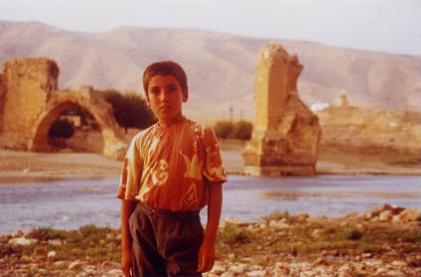
A Kurdish boy in front of the bridge in Hasankeyf, Turkey, which will be drowned if the Ilisu Dam is built. The base of the bridge dates back to the 7th century
©International Rivers Network Kurdish Human Rights Project
~~~~~~~~~~~~
The Iraqi people haven't been through enough. Now they have to worry about their water being taken away...what little they have. Isn't it also so coincidental that where ever we start a war, water is an issue as well as oil? Isn't it also so outrageous how history can simply be washed away without a thought when greed takes over that process?
~~~~~
Iraq Worried About Turkish Dam
SHARING THE TIGRIS RIVER
Iraq Worried about Turkish Dam
The Ilisu Dam will, when it's finished, provide hydroelectric power in south-eastern Turkey. Iraq, though, is worried it may also cut flows of the vital Tigris River.
Officials in Iraq are angered by Turkish plans to construct a gigantic dam on the river Tigris in southeast Turkey, near the Iraqi border. The so-called Ilisu Dam's 300 square kilometer reservoir would be a significant source of hydroelectric power, and Turkey's Prime Minister Recep Tayyip Erdogan said at an opening ceremony on Aug. 5 that it "will bring big gains to the local people." But in Iraq, health officials are concerned that these gains will come at the expense of their own people.
Photo Gallery: The Treasure Turkey Will Lose
Click on a picture to launch the image gallery (6 Photos)
"There is no doubt that this will lead to a significant deterioration of the water quality" in Iraq, said Latif Rashid, Baghdad's Minister of Water Resources, in a letter to the Germany-based NGO World Economy, Ecology and Development (WEED). Iraq is also concerned that the new dam project could hamper the flow of water into the country via the 1,900 kilometer long Tigris River. The river begins in Turkey and flows into Iraq through the south-eastern Turkish town of Cizre.
The Ilisu Dam is part of the larger Southeast Anatolia Project, a 21-dam plan to expand hydro-electric energy production in the under-developed and largely Kurdish southeast. But it's a project that is no stranger to international criticism with the Ilisu Dam attracting particular attention. In 1999, the Kurdish Human Rights Project (KHRP) revealed that its completion would result in the flooding of Hasankeyf, an ancient city of particular cultural import to the Kurdish minority. Criticism has only grown since construction started in August.
Now, though, even the German government is worried about the construction's potentially negative effects on Turkey's troubled neighbor, Iraq. The project is being realized by an international consortium of construction firms, including the German firm Züblin. Officials in Berlin now face the delicate decision of granting export credits to a controversial project.
Government officials on Friday said that Ankara would need to guarantee the minimum water levels for neighboring Iraq before it would approve export credits. But WEED spokeswoman Heike Drillisch urged the government not to support the initiative. "The complaints from Baghdad show that international standards and human rights are being ignored," she said.
Meanwhile, the Turkish Foreign Ministry reacted with indignation to the accusations. It played down the Iraqi complaints, asserting that Iraqi delegates have not even mentioned the issue in direct talks with Turkey. A spokesperson for the Turkish government gave assurances that minimum water levels would be maintained for Iraq, and that the government is open for talks.
amb/spiegel
~~~~~~~~~~~~
This is a very comprehensive site regarding the entire Ilisu Dam project and the socio-economic, political, and environmental impacts of this project that in my view is only being done for political blackmail.
The Ilisu Dam Project
Make no mistake about it: with drought in this area already causing water tables in the Tigris to be at only 50% capacity or lower, this dam will only make matters worse for those who rely on the Tigris for sustinence, and that could lead to conflict for this most precious resource of the Middle East.
The Water Wars
And again, what side does the U.S. fall on in this? The Bush regime occupies Iraq, brings about a civil war that is killing thousands of people including our own, and then dares to say we bring Democracy in the face of destroying their infrastructure (including water) in the face of all of this?
Despicable.
Also see my other entries on this topic:
The Ilisu Dam Controversy
Iraq's Marshes, Corporate Control, and Water Scarcity
Subscribe to:
Posts (Atom)
Another World Water Day Gone
We see another World Water Day pass us by. The theme, Water For All, signifies that though some progress has been made we are woefully behin...

-
 There is no more of an insidious killer than drought because of its subtlety and silence. It creeps across the land and air sucking out its ...
 -
Desert Nomads by Richard Harris Morning Edition, July 2, 2007 · Climate change threatens ice sheets and ecosystems, but it also threatens hu...
-
 Lake Tuz No Longer Second Largest Lake in Turkey Lake Tuz, located in central Anatolia and known as the second-largest lake of Turkey, can n...