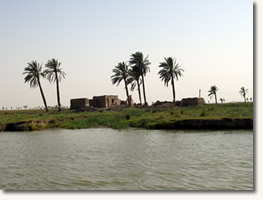
Euphrates River
~~~~~~~~
Why isn't Saddam Hussein on trial for this? For what Hussein did in diverting water from those who needed it simply to punish them politically was clearly a human rights abuse. However, we never hear of this from the "occupying force" there. Why not?
Iraq Marshes' Recovery In DoubtThe long-term recovery of the Iraq marshlands is in doubt because of uncertainties over water supplies to the wetlands, research suggests.
The first study to look at the marshes' recovery warned that increased water demand from farmers and cities could lead to only a portion being restored. Large areas were drained in the 1990s to punish the Marsh Arabs for rebelling against former leader Saddam Hussein.
The findings will be presented next week to the British Ecological Society. Curtis Richardson, from Duke University, North Carolina, US, who led the research, warned that the recent faster-than-expected pace of recovery was unlikely to continue in the long term.
"Our recent field studies have found a remarkable rate of native species re-establishment - of macroinvertebrates, macrophytes, fish and birds in re-flooded marshes.
"But the future availability of water for restoration is in question because of increasing urban and agricultural demands for water in Iraq, as well as in Turkey, Syria and Iran, suggesting only a portion of the former marshes can be restored, " Professor Richardson observed.End of Eden?
The Iraq marshes, sometimes identified as the site of the Garden of Eden, once covered an area twice the size of the Florida Everglades and were famous for their biodiversity and cultural heritage.
Saddam's dams diverted waters away from the marshes
A study in the 1970s said the marshlands were home to more than 80 species of birds, including about 90% of the world's population of the Basra reed warbler (Acrocephalus griseldis).The wetlands also served as important fish spawning and nursery grounds, as well as acting as a natural filter for waste and other pollutants.
Tens of thousands of Marsh Arabs who lived in the area depended on the habitat for fishing and as grazing sites for their buffalo herds.
The marshes were devastated in the 1990s after Saddam Hussein's regime diverted water away from the region. This reduced the marshlands, the Middle East's largest wetlands, to just 7% of their original size of 15,000 sq km.End of excerpt.
Some history:
The Iraqi Government Assault On The Marsh Arabs/Human Rights Watch~~~~~~~~~~~
Eden AgainAn organization working to restore the Mesopotamian Marshlands.
Most of the Iraq water resources originate from outside Iraq where 88 percent of the natural runoff of the Euphrates comes from Turkey, 9 percent from Syria and the remainder from Iraq. As for the Tigris, 56 percent of its natural runoff comes from Turkey, 12 percent from Iran (especially for the two tributaries, lower Zab and Diyala rivers), while source of the remaining water is from within Iraq.
Information:
Iraq Marshlands RestorationThe total length of the Tigris river is about 1900 kilometers, of which 1415 are located inside Iraq. The average annual runoff, recorded for many years at the Turkish borders, is about 16.8 billion cubic meters (BCM). Other tributaries flow into the Tigris inside Iraq’s territory, of which Khabor, Upper Zab, Lower Zab, Adhaim and Diyala are the most important. The average inflow of the Tigris River, both from inside and outside Iraq, is around 44 BCM.
Euphrates River
The total length of the river is 2940 kilometers, of which 1160 are situated inside Iraq. The average annual runoff of the river at the Turkish-Syrian border, before the building of the dams for irrigation projects in Turkey, was 30.4 BCM. The river has no tributaries inside Iraq.
Both the Tigris and Euphrates rivers are controlled by a series of dams and barrages. They were built to control the flood season where the inflow water exceeds the need for water in the country and to maintain reasonable water storage for summer when the requirements may exceed the inflow within the river and their tributaries. The annual distribution of the inflow of water resources in Iraq is as follows:
• February - June 7 percent
• July - October 10 percent
• November - January 15 percent
The two rivers and their tributaries are controlled by 25 dams and dikes in addition to 275 irrigation-pumping stations. Water released from the dams is justified mainly by the total requirements down stream. However, some water releases are adjusted according to the needs of hydropower generation.
~~~~
Ok, now that you know from whence the water comes, think about this.
Bechtel Corporation: Blood For Water/By Dr. Vandana ShivaWhy again if Iraq is a "Democratic" country receiving so much "aid" can the
people of Iraq not have sovereignty over restoring this natural wonder, and why is water then so scarce for the people in this region? Why is US AID now involved in this "altruistic" effort all of a sudden pledging so much for it's restoration when people in Iraq still don't have electricity, and after we all sat watching this environmental disaster unfold without doing anything about it? Well, it is the same reason why countries like Iraq in the Middle East will continue to be targets in the 21st Century as was mentioned above:
The War For Iraq's WaterOne of the many claims of barbarism on the part of Saddam Hussein and his Ba'athist regime is displacing hundreds of thousands of Madan, or Marsh Arabs, and draining the legendary swamps where millennia-old culture had been practiced and preserved. In post-war Iraq, the United States has assumed the responsibility of restoring these marshlands. The United States Agency for International Development (USAID) has been a vocal proponent of bringing water to the arid landscape, addressing the humanitarian needs of the remaining Marsh Arabs, and fixing the ecological crisis which, according to the UNEP, has vanished about 90% of the 20,000 square kilometers of Iraq's marshlands.9
While addressing the marshland concerns attempts to smooth over twelve-year-old political rifts between the American administrators now governing Iraq and the displaced Madan people, it seems somewhat odd that such a relatively isolated minority of the Iraqi population would receive such attention and consideration so immediately after the war, especially since the Madan are Shi'a, a population that has largely rejected the occupying American forces and has rejoiced at the return of Islamic leaders from exile to Iraq.
And yet, American interests are moving forward swiftly.
Bechtel, an American firm with a controversial history of water privatization, who won the largest contract from USAID to rebuild Iraq's infrastructure, is set to be a major player in the process with a contract worth $680 million. Bechtel's history speaks for itself.
Blue Gold, a book exposing global control of water by private corporations, listed Bechtel in the second tier of ten powerful companies who profit from water privatization.10 According to Corpwatch, two years ago current USAID administrator Andrew Natsios was working for Bechtel as the chairman of the Massachusetts Turnpike Authority, a massive transportation project in Boston whose cost has inflated exponentially in the billions of dollars.11 While providing political disclaimers on its website as a result of investigative reporting centering on the close relationship between government and private business, Bechtel certainly will benefit from its positioning as the sole contractor for municipal water and sanitation services as well as irrigation systems in Iraq.
Vandana Shiva also implicates Bechtel in attempting to control not only the process of rebuilding Iraq's infrastructure, but also control over the Tigris and Euphrates rivers themselves.12 Bechtel has been embroiled in a lawsuit with Bolivia for their plan to privatize the water there, which would drastically rise the cost of clean water for the poorest people in the country. To control the water in the Middle East, Bechtel and its fiscal sponsors, the United States government, would have to pursue both Syria and Turkey, either militarily or diplomatically. Syria has already felt pressure from the United States over issues of harboring Iraqi exiles on the U.S.'s "most wanted" list, as well as over issues of terrorism and weapons of mass destruction.
It is not stretch of the imagination that a company like Bechtel with a history of privatization would have its sights set on water in the Middle East, starting with their lucrative deal in Iraq. However, the United States is not positioned to enter a new phase of global geopolitics where water, a limited vital resource that every human needs, is the hottest commodity and where American corporations like Bechtel have not already capitalized on the opportunity to obtain exclusive vending rights.
Devoting attention to restoring the marshes clearly serves U.S. businesses and corporations who have control over which areas of the marshes get restored, and which ones get tapped for their rich oil resources. Control of the marshlands by the U.S.-led interim government and by the American corporations who have won reconstruction contracts is crucial in deciding where new oil speculation will take place. If only a percentage -- 25% according to experts on a Brookings Institution panel on marshland reconstruction -- can be restored, then it would behoove those working on issues of oil and water not to rehydrate areas where such oil speculation will likely take place.
Water is vital to the production of oil as well; one barrel of water is required to produce one barrel of oil. Bechtel and Halliburton, who received a U.S. Army contract to rebuild the damaged oil industry which will likely reach $600 million,
are the two most strategically-positioned corporations to control both the water and oil industries in Iraq. Yet this ruse of generous reconstruction and concern seems both an unlikely and peculiar response after a less-than-philanthropic U.S.-led invasion of the sovereign nation of Iraq. Supporters and opponents of the war alike could hardly miss its transparency. Whether the reasoning was because of oil, liberating the Iraqi people, ferreting out weapons of mass destruction or exerting regional influence, few pretenses were made to distance the war profiteers from the battlefield in the war's wake.
The actions of agencies like USAID, which has pledged more than a billion dollars to facilitate rebuilding infrastructure in Iraq which the U.S. military and policymakers had a large hand in destroying, are far from altruistic. The problem of the Marsh Arabs was not invented overnight at the end of the recent war, but rather has developed in plain view of the whole world via satellite images and documented in-country reports of displacement and abuse. Moreover, the marshlands are not Iraq's sole antiquity. Museums, regions and sites of archaeological importance were destroyed, bombed and looted not only during this last war, but also continuously since the first Gulf War. Will we be paying to rebuild those as well?
According to Peter Galbraith, a professor at the Naval War College, three weeks of ransacking post-war Baghdad left nearly every ministry in shambles, including the Irrigation Ministry, except for the Oil Ministry that was guarded by U.S. troops.13 The people of Iraq are becoming rapidly disenchanted with a prolonged U.S. presence in their country as their former disempowerment under Saddam is translated into present disempowerment under the Americans.
According to those working closely with the project to rehydrate the marshlands, in the newly "liberated" Iraq the silenced voices of the oppressed peoples can now be heard and addressed, the stories of destruction can be told and the much-needed healing of humans and terrain can take place. Whether this will actually happen is another story. At the Brookings Institution forum on the marshlands, no native Iraqis were represented, and the larger question arising in the post-war reconstruction of Iraq is what tangible legitimacy is given to voicing the will of the people by putting representative Iraqis in power.
End of excerpt.
~~~~~~~~~~~
They didn't go into Iraq just for the oil.... They went there to control the resource that is ultimately the most precious to the people there. Saddam Hussein may have drained the marshes in a blatant human rights abuse, but we are no better in our treatment of the resources in Iraq and the Middle East. The motivation is still the same, POLITICAL AND ECONOMIC CONTROL, and it is a disgrace.
It's blood for water, blood for corruption, blood to keep the military/industrial complex humming. And instead of working to bring control of resources back to the people of Iraq with the sincere motivation of restoring all we destroyed, it is being privatized for profit. Seems Hussein and this government work very well together.

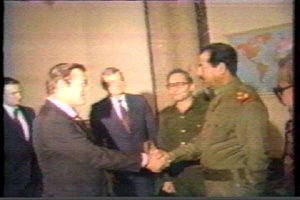
Shaking Hands: Iraqi President Saddam Hussein greets Donald Rumsfeld, then special envoy of President Ronald Reagan, in Baghdad on December 20, 1983.
Shaking Hands with Saddam Hussein:
The U.S. Tilts toward Iraq, 1980-1984
~~~~~~~~~~~~~~~~~~~~~~~~~~~~~~~~~~~~~~~~
General Reference on the growing water crisis in the Middle East:
Water In The Middle East